
November 2026
Maggie Ellis
A conversation about light and dark, studio as laboratory, and why being an artist is a little childlike. (That's a good thing.)
Interview by Dan Golden
I wanted to start with your process. You're a figurative painter, but I read that you begin each painting with an abstract gesture. How does that first mark guide what comes next?
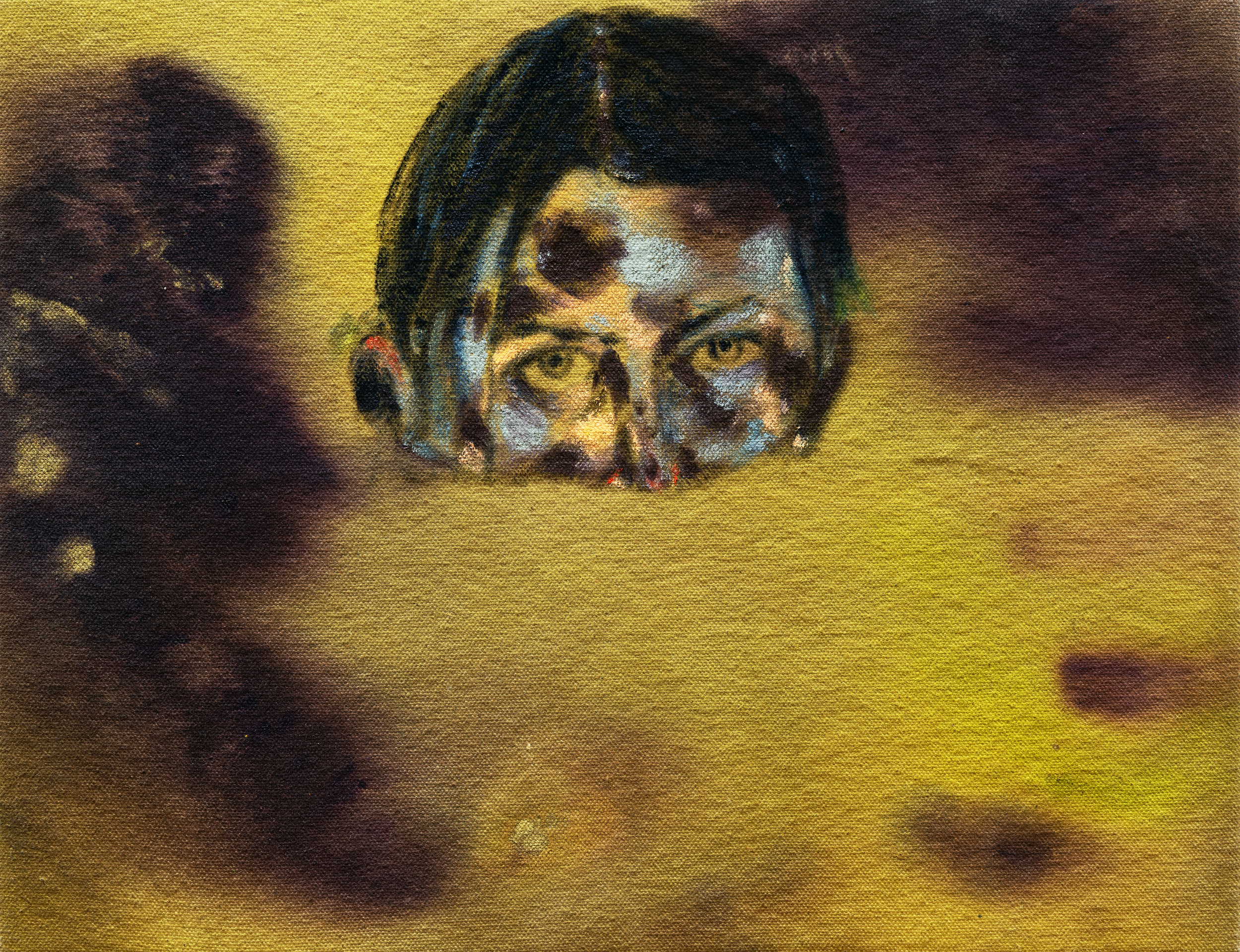
Typically, I have a feeling for the color palette before I make any gestures on the surface. The palette helps guide the abstraction, which becomes something of a premonition for the rest of the painting. Those initial layers are a way of looking into the possibilities of the work, of sensing what the painting might become before its forms begin to emerge. When I start to populate the surface with figures and other elements, I'm working within a space that is already charged with color, light, and texture. The abstraction gives me a much clearer sense of the painting than I would have if I began with a blank white canvas.
You grew up in Georgia. How did growing up there shape your sensibility and, by extension, approach to painting?
Growing up, my parents hosted a lot of parties in our basement. I was usually on the periphery, eavesdropping on conversations. There were all these family friends with fascinating stories and crazy nicknames. I was surrounded by music and wild, sometimes seemingly endless stories, and I absorbed it all. I think that experience made me an observer of my surroundings and the people in them. I've always been interested in what someone's story might be, or what they want you to believe their story is. I'm fascinated by the fictions people create for themselves. Part of what I sometimes do in my work is elaborate and exaggerate that perceived fiction.
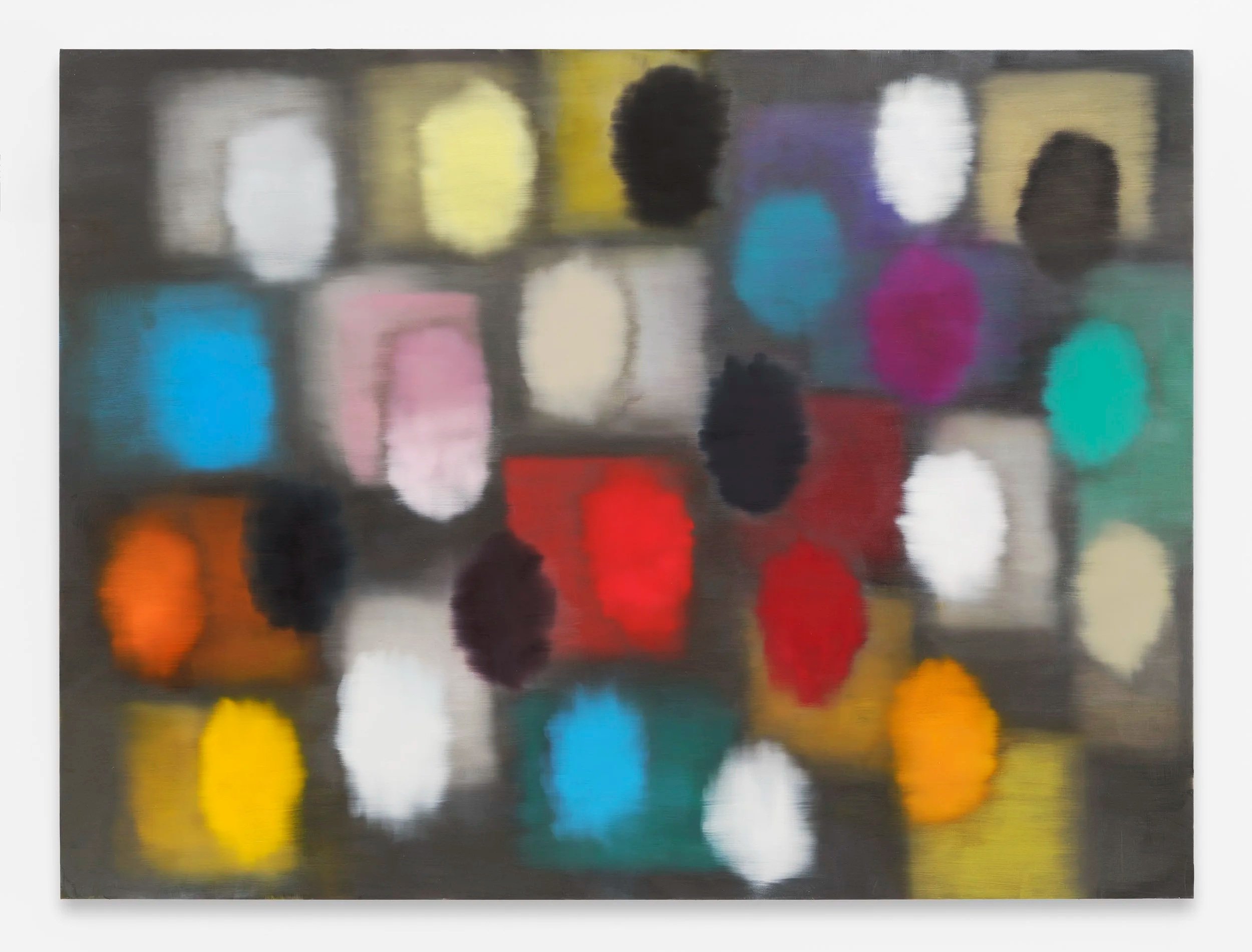
Ross Bleckner, Everyone, Someone, 2023, oil on linen, 72 × 96 inches (182.9 × 243.8 cm). Courtesy of the artist, Guild Hall, and Petzel, New York.
Your artistic influences include painters ranging from Bruegel to Otto Dix to R. Crumb, Alice Neel, and Cindy Sherman. Can you share what resonates with you about those artists in particular?
I look to a lot of artists, and these are just a small fraction of the people whose work I'm thinking about. In the studio, I surround myself with tall stacks of books. I'm always flipping through these towers, searching. Sometimes I need to see an example of someone painting very graphically, like Max Beckmann, or I want to see how Piero della Francesca and Botticelli painted leaves. Whichever book is open at the top of the stack is what I need to see at that particular moment. It's become an effective way for me to problem-solve in the studio, this oblique strategy for myself.
I'll always love Bruegel for the way he handles crowds and composes scenes from a distance. There's an absurdity and outrageousness in his paintings that reveals itself slowly, through the details, rather than announcing itself all at once. I've always admired Alice Neel's particular vision of New York, as well as her assertiveness and the extraordinary care she brings to her subjects and their personalities.
In Otto Dix, I'm drawn to the grotesque, the ugliness, and his willingness to confront the darkest realities of war, particularly in his drawings and watercolors. I look to his portraits the most. I can always see the sitter's aura. Each one is rendered with its own color palette and texture. The faces are filled with these garish color combinations. You can feel the angst and trepidation; everyone is a little bit haunted. All of those piercing emotions pour from his subjects, something I am always thinking about when painting figures. In Otto Dix's paintings, every figure seems to assert their reason for existing, as though he writes it into their expression.
I've recently been looking at Cindy Sherman's work, specifically her series of photos of mannequins and sex dolls. The fake body parts speak directly to the uncanny. She uses lighting, color, and high contrast to heighten the drama in what is already a freaky image. The photos are glossy, and the darks are extra dark and deep, like the blacks in a Holbein painting. All of this establishes the mood and tone. What intrigues me most is how those images are staged. I think about this often: How can I "set the stage" through composition and the direction of the light? How can I direct the scene in the painting?
Ross Bleckner, Everyone, Someone, 2023, oil on linen, 72 × 96 inches (182.9 × 243.8 cm). Courtesy of the artist, Guild Hall, and Petzel, New York.
I'd never seen a line between the work of R. Crumb and Bruegel until our conversation—but now I see them both sharing a fascination with humanity in all its beauty, absurdity, and grotesqueness. Do you share that fascination?
Absolutely. R. Crumb was a big influence on me during the pandemic. I was making hundreds of drawings of strangers I encountered around the city. It was such a strange and dark period, and people were behaving in increasingly bizarre ways. A woman in my neighborhood would walk around carrying a six-foot-long tree branch with a flag attached to the end, waving it at people to keep them away. The bizarre was becoming normalized. I was drawing these kinds of encounters while also trying to find my own voice.
I was fascinated by Crumb's over-the-top, sardonic wit and his unflinching take on humanity's grotesqueness. Bruegel shares that fascination, though he approaches it more subtly. That these sensibilities persist across centuries amazes me. Bruegel is still an artist I return to often. For me, he embodies the fantastic and the impossible.
You moved from Georgia to New York and earned your MFA at Hunter College. What was your experience at Hunter like, and how do you like being a real New York artist? (seriously!)
I moved to New York from Atlanta in 2014, after living there while earning my BFA in Painting at SCAD. It was a major turning point. Suddenly, I found myself in an MFA program in Tribeca, part of a large community of artists, in a city filled with galleries and museums. Everything I encountered in New York during those years became part of my experience and, inevitably, influenced my work.
My time at Hunter was tumultuous. I had left the South for one of the most metropolitan cities in the world, all while trying to find my voice as an artist. I was grappling with where I came from and my own personal history, while simultaneously trying to understand who I was becoming as an artist. It was a challenging period. In many ways, I was stuck in the past, trying to make sense of it all, and much of that tension found its way into the work I was making.
I remember one critique in particular when someone described me as a "tough Southern woman in the kitchen making a casserole." It was such a one-dimensional characterization, reducing me to a kind of caricature I knew I wasn't. I never forgot that comment. I think it also reinforced how I see the world. Even now, my perspective on New York is that of an outsider, someone looking in from the periphery.
Ross Bleckner, Everyone, Someone, 2023, oil on linen, 72 × 96 inches (182.9 × 243.8 cm). Courtesy of the artist, Guild Hall, and Petzel, New York.
Turning to your new exhibition, Chaos Bewitched, can you tell us a little about the show and what you're exploring in this body of work? I understand the title comes from Moby-Dick?
The title Chaos Bewitched comes from a description of a painting in Moby-Dick.
While reading the book this year, I was struck by a passage near the beginning in which Melville describes a painting hanging in a bar called the Spouter-Inn. He describes it as a "large oil-painting so thoroughly besmoked, and every way defaced…" What resonated with me was how he describes this imaginary painting and how its dark, confusing image gradually reveals itself to the viewer. The painting doesn't actually exist outside of its description in the book, yet Melville makes you feel as though you're standing in front of it, trying to decipher what you're seeing.
There are so many ideas in Moby-Dick that I'm interested in exploring through painting: death, the sublime, characters with their own histories, the grotesque, the mysterious, and an overwhelming sense of foreboding. In a way, this body of work is my attempt to "delineate chaos bewitched" through painting. Some ideas can't be contained in a single painting. I found myself needing to keep going, exploring them across different scales, from a small nine-inch painting to a panoramic work measuring 100 inches.
Your painting Perpetuity is a real standout piece. It has an almost theatrical quality, with an extraordinary cast of figures. Do you think of the people who populate your paintings as characters with their own stories?
The figures in Perpetuity are no longer alive. I think of them as spirits, each with their own story and history, which becomes manifest in their physical appearance. Some are actively disappearing, while others seem to be composed of abstraction. They're all moving through some kind of purgatory toward an archway in space.
I thought about being in Bonaventure Cemetery in Savannah, Georgia—the intense heat and humidity under sun-speckled trees draped in Spanish moss. I wanted to bring that feeling into the painting, to make the air feel thick and tangible, surrounding all the figures.
Ross Bleckner, Everyone, Someone, 2023, oil on linen, 72 × 96 inches (182.9 × 243.8 cm). Courtesy of the artist, Guild Hall, and Petzel, New York.
I've always thought it takes a special courage to be a painter—to face a blank canvas and make something entirely your own. In 2026, with everything moving so fast and AI about to take over the world, what gives you the conviction and fortitude to paint?
Honestly, AI has nothing to do with painting. Painting relies on a visual literacy that AI doesn’t have.
I also don't think of painting as a particularly courageous act. It comes very naturally to me. Painting is how I make sense of the world; it's how I work through ideas and give expression to things I might not otherwise be able to articulate. Philip Guston said painting cannot be willed, but must be felt. I think about that often in the studio. When I'm painting, I want to quiet my logical mind and get closer to intuition and feeling.
AI doesn't have feelings or an imagination of its own. It draws from what already exists, compiling and rearranging images in response to a prompt. When I walk down the street, I see AI-generated menus and posters everywhere. People seem impressed by the imagery it produces, but to me, it looks gross. All the food looks like it's covered in maggots.
So honestly, I don't think about AI as it relates to my practice; it doesn't occupy any space in my brain.
I'm always curious about the daily rhythms of an artist's practice. What does a typical day in your studio look like? Do you have particular routines or rituals? Do you listen to music while painting?
The first thing I do in the morning is draw my dreams. They often become the starting point for ideas that eventually find their way into my paintings. I take care of emails, errands, calls, and whatever else needs my attention before heading to the studio, so that I can arrive with a clear head. I try to keep my life outside the studio as regimented and organized as much as possible. That way, once I'm in the studio, I can let go and be as wild as I want to be as I paint.
Music is always part of the process. I have a growing vinyl collection and make tons of playlists for different seasons, moods, and weather. What I listen to depends on how I'm feeling or how I want to feel. I love the soundtrack to The Shining, which features some terrifying compositions by the Polish composer Krzysztof Penderecki. That always gets my heart rate up, as does Nine Inch Nails' The Downward Spiral. With the gloomy fall weather, I've been listening to a lot of Deerhunter, Weyes Blood, and Brian Eno.
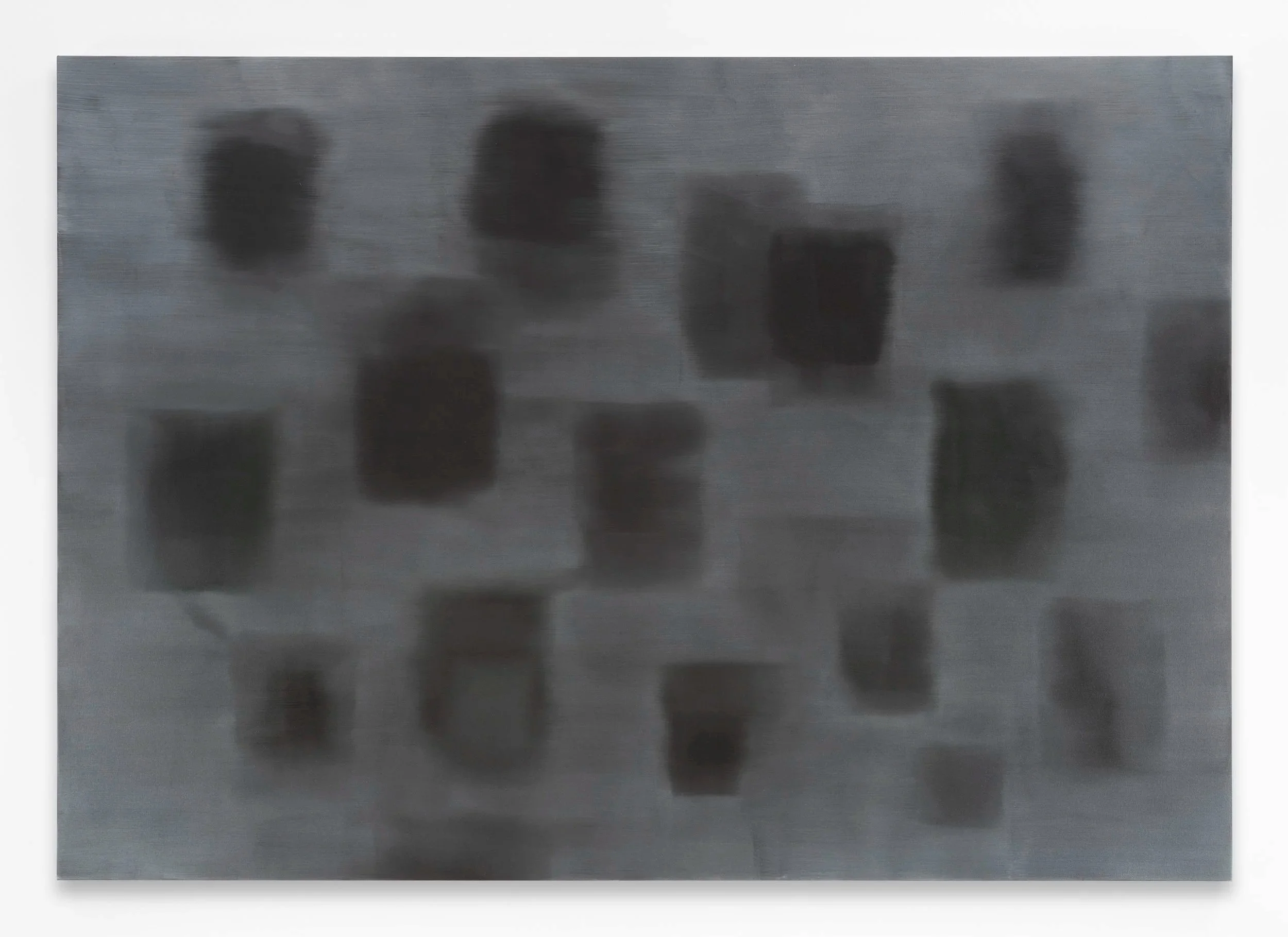
Ross Bleckner, To Speak Lower, 2023, oil on canvas, 84 × 120 inches (213.4 × 304.8 cm). Courtesy of the artist, Guild Hall, and Petzel, New York.
Ross Bleckner
Octopus
Petzel
New York
September 17—October 24, 2026