July 2026
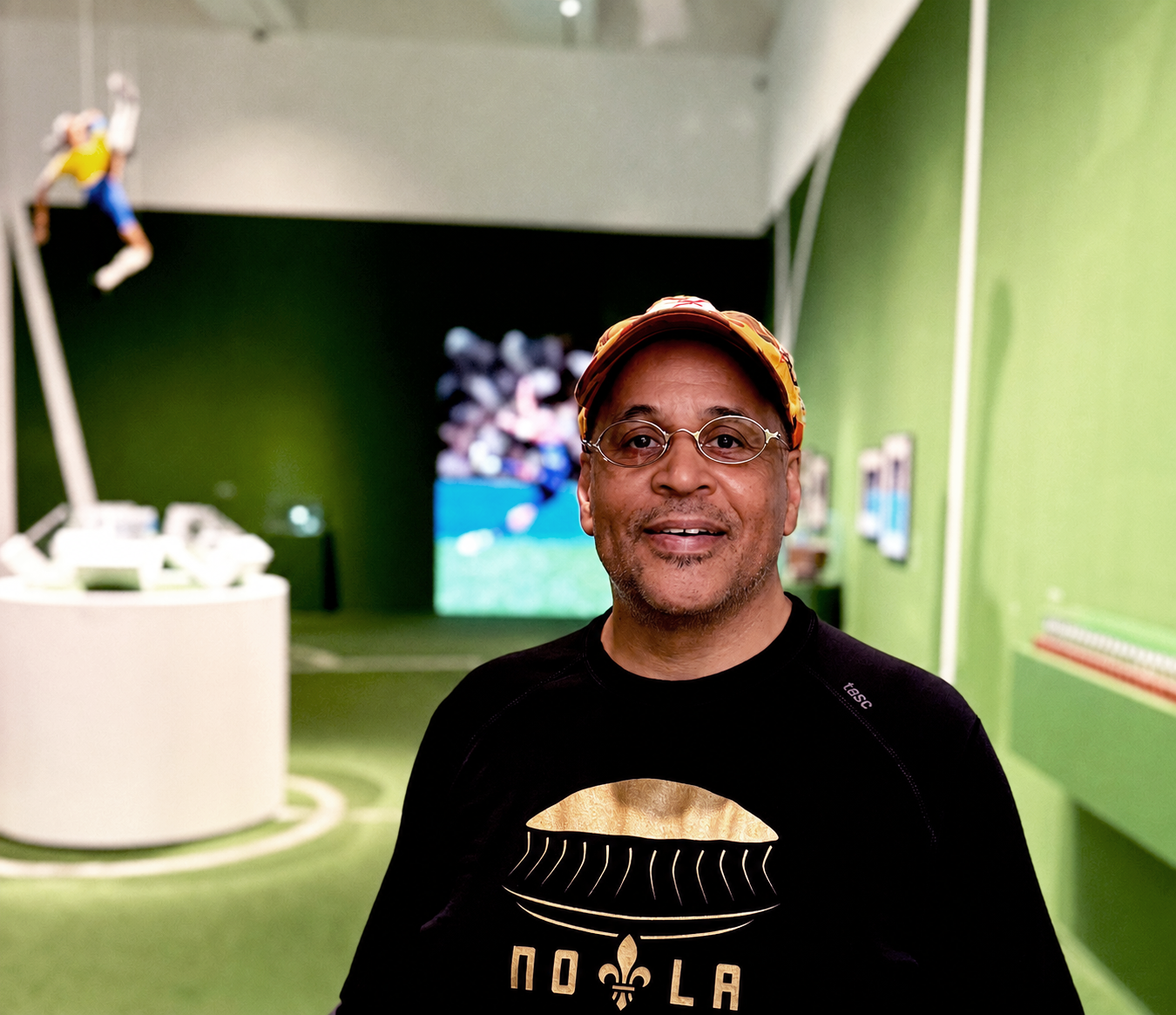
Lyndon Barrois
Fútbol Is Life
Exhibition ends July 26
A conversation with the artist about material and motion, the connection between sports and politics, and his solo exhibition at the Los Angeles County Museum of Art.
Interview by Dan Golden
PART ONE | STUDIO
Let's start at the beginning—what are your earliest memories of making art?
I grew up in New Orleans, and like any kid, I played with stuff—clay, Play-Doh, phone wire, aluminum foil, anything I could get my hands on. I’d make people, animals, whatever. Just having fun. Back then, there was no digital anything, so you had your physical toys—action figures, the electric football set, G.I. Joes, Hot Wheels. Being into sports, I gravitated toward athletes and movement. But the electric football guys annoyed me—they were stiff; they didn’t move.
How did you land on Wrigley's gum wrappers as one of your primary art materials?
My mom loved Wrigley’s gum. One day, I picked up a wrapper and realized it was perfect: foil on one side, paper on the other. Those were two of my favorite materials, and together, they opened up new possibilities. I started making figures out of them. When I kept the paper side out, I could color them with markers. That was a revelation—I was maybe ten or eleven. Suddenly I could make people who actually moved, not stuck on one axis. I made tiny drivers for my Hot Wheels, then athletes, then whole teams. I just never stopped. I was making my own toys, my own way.
Before art school, you were already working professionally as a graphic designer?
I went to Delgado Community College and got solid training there. In ‘84, I tried to do an Olympics poster—sent two designs, but it was too late. The publisher offered me the ‘85 Boston Marathon instead, and then the ‘86 Jazz and Heritage Festival. When the Pope came to town, I designed a poster for a church. My focus then was graphics and posters—not miniatures.
And all that time, you were still making the figures on the side?
Always, just for fun. After Delgado, I got a scholarship to Xavier University to study under John Scott—an incredible mentor who won a MacArthur Grant while teaching us. While I was learning all the formal disciplines—drawing, painting, sculpture—I kept making miniatures on the side, refining the teams, even making horses. But I never thought of it as art. I was too focused on learning the “real” stuff to make the connection.
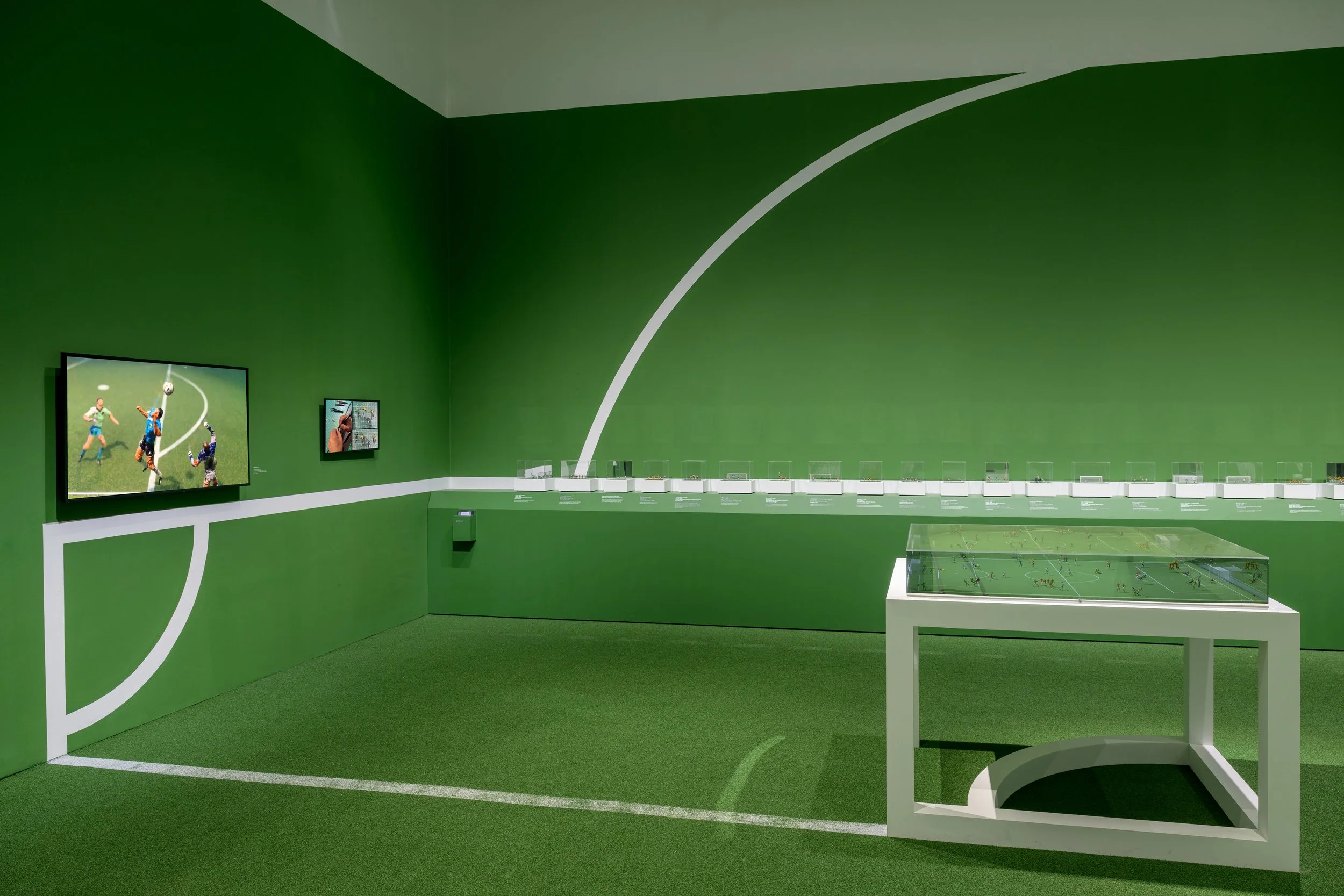
Installation view, Fútbol Is Life: Animated Sportraits by Lyndon J. Barrois, Sr., at the Los Angeles County Museum of Art, Feb 15–Jul 26, 2026, © Lyndon J. Barrois, Sr., photo © Museum Associates/LACMA, by Jonathan Urban
What did you study there, and where did it lead?
Animation—to make these things move. That was the goal. I showed CalArts everything I’d done and storyboarded what I wanted to create. I started with a short film of the 1975 World Series and then a longer football sequence. For my thesis, I made a film about the Black jockeys who dominated the early Kentucky Derby, making over 20 horses. That film ran at several festivals.
After CalArts, my first film was supposed to be Mars Attacks in stop-motion, but the studio switched to CG after Toy Story and Jurassic Park. I joined Rhythm & Hues as a character animator, learning digital tools as the industry shifted from 2D and stop-motion to CG. I worked my way up to animation director on The Matrix sequels, spent a lot of time on set, later worked on Happy Feet, and developing projects now with Lilly Wachowski’s company.
Was your art practice always running parallel?
Always. My professor at Xavier was making a living as an artist. Coming out here, Janine and I have been collecting for about 25 years now. Henry Taylor, Mark Bradford and l attended CalArts at the same time. You just see the examples around you. My career was in animation and visual effects, but I was always making my own work on the side. That was my balance.
So, when did the shift toward focusing on your own work happen?
My son—also a professional artist, who taught at Carnegie Mellon and was running a graduate department there—told me years ago: “Yeah, it’s cool you do all those movies. But you’re the only one on the planet doing what you do. Focus on your work.” Since then, I’ve been in seven or eight museums, done a lot of gallery shows, and sold pieces. This is my first museum solo. And I just completed my fourth museum acquisition.
So what happened when it came time for your senior show?
I had no idea what I was going to do. The Super Bowl was coming to New Orleans—Super Bowl 24—so I thought maybe I could do something with it. I always drew posters for games just for fun. So I showed John my miniatures. He said, “What is this? What game is this?” I said, “These are things I make.” He goes, “You make these?” I told him I’d been making teams and athletes my whole life. And he said, “I don’t think you know what you’re sitting on.
That hit me. That’s when I decided to make dioramas. I made dioramas of great moments from the previous 23 Super Bowls. All 23. Then my buddy Danny Wilson and I hit the pavement looking for a gallery. Got a lot of no’s. Finally, I found a gallery on Baronne Street in the Warehouse District. A woman named Jana Napoli ran an organization called YAYA—Young Aspirations Young Artists. She worked with inner-city high school kids, teaching them skills for creative careers. I went to see her, and she said, “Yeah, you can have your show here—on one condition: you work with my kids.” Done. I got a venue.
The show opened in late January 1990. I was 25, just about to graduate. HBO Sports picked it up. PBS. Newspapers. The Today Show. And Ripley’s Believe It or Not bought a bunch of the pieces. That was when I said—this is a serious art form. I need to make a plan.
And that led you to CalArts?
I applied to grad programs at a few Big Ten 10 schools in communication design. Got rejected. Then Jana introduced me to CalArts—dropped a catalog on me and said, “This is where you need to be.” I applied and got in immediately. That was ‘92, with about a year and a half in between. I stayed on staff at YAYA, worked with the kids, then made the move.
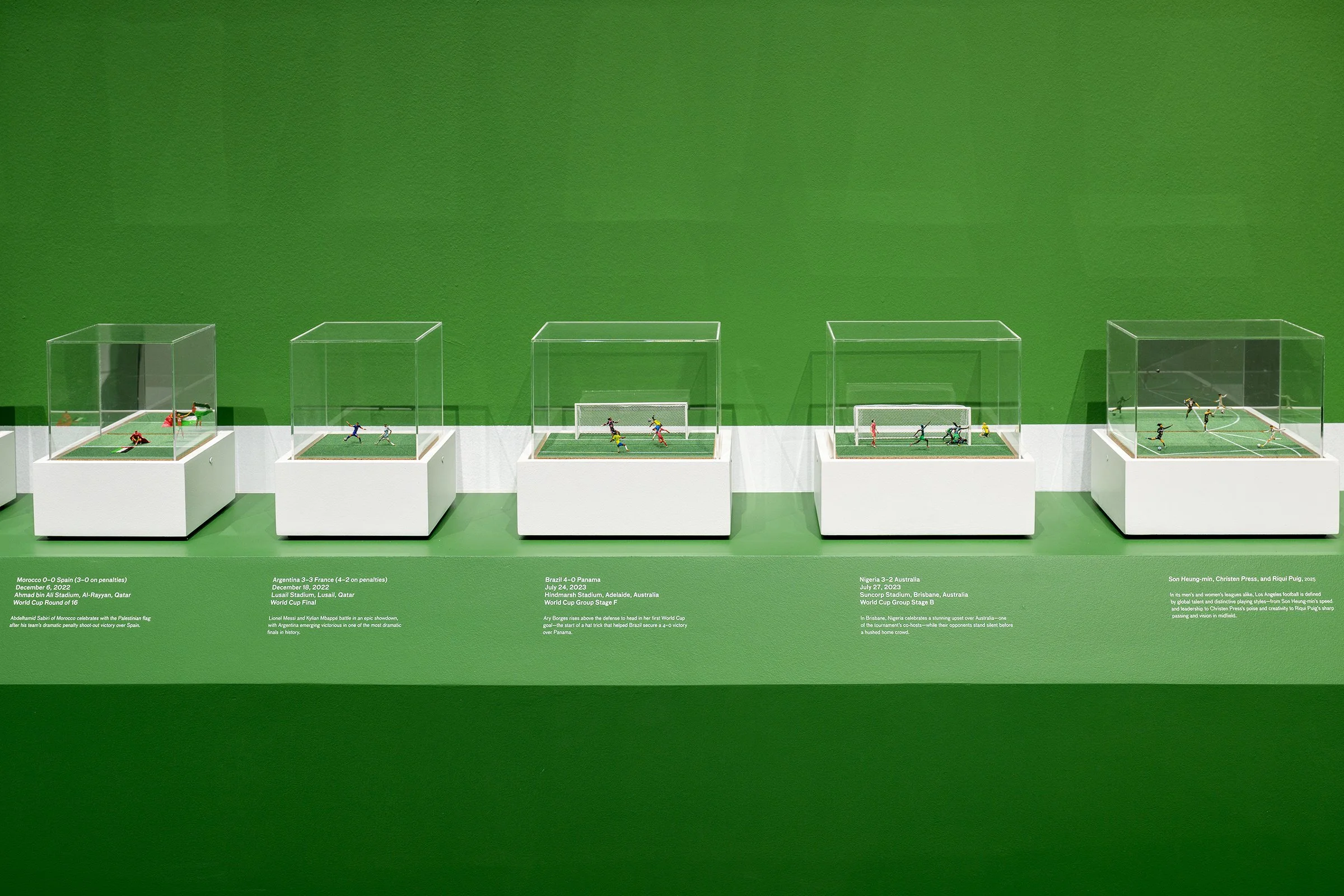
Installation view, Fútbol Is Life: Animated Sportraits by Lyndon J. Barrois, Sr., at the Los Angeles County Museum of Art, Feb 15–Jul 26, 2026, © Lyndon J. Barrois, Sr., photo © Museum Associates/LACMA, by Jonathan Urban
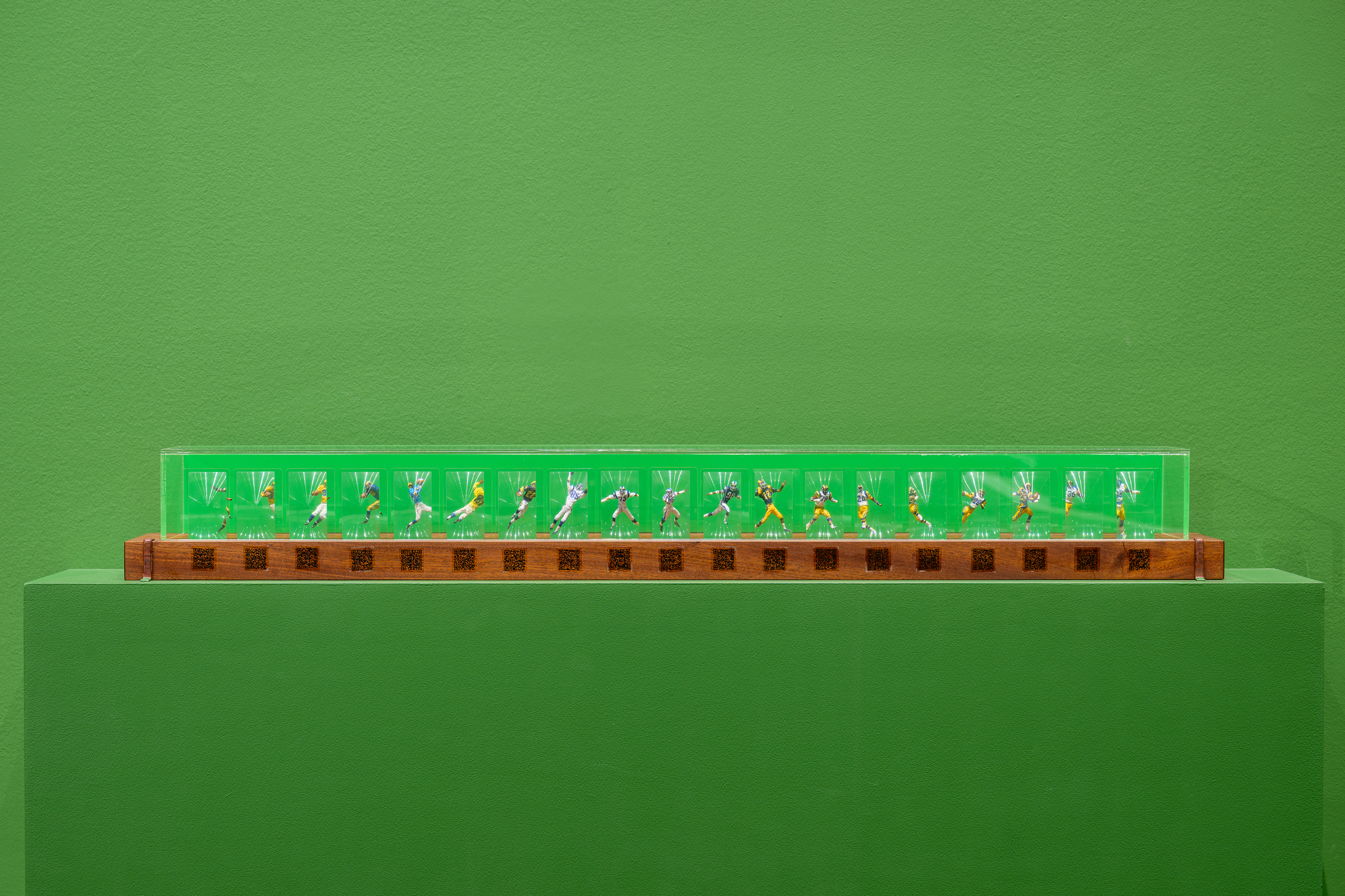
Installation view, Fútbol Is Life: Animated Sportraits by Lyndon J. Barrois, Sr., at the Los Angeles County Museum of Art, Feb 15–Jul 26, 2026, © Lyndon J. Barrois, Sr., photo © Museum Associates/LACMA, by Jonathan Urban
PART TWO | EXHIBITION
How did this show come together?
Franklin Sirmans—who now runs the Pérez Museum in Miami—was at LACMA before that. In the art world, people knew us as collectors and knew me from visual effects. They didn’t know I was a practicing artist. I couldn’t get Franklin to see what I was doing. Then he goes to Pérez, and in the meantime, I start posting on Instagram. Franklin sees the work and goes, “What is this? Can you do soccer?” I said, of course—that’s what I was trying to tell you three years ago. So he invited me to do a piece for that group show. A few years later, LACMA acquired it. That was my first major museum acquisition. And now this is my first museum solo and that work, FútBallet, is the centerpiece of the show.
Walk me through some of the key pieces, starting with the large centerpiece diorama.
The timeline runs from 1930 to 2023. These are moments from the tournament that were meaningful to me—not necessarily the biggest scores, but ones that had an impact during my research. Like this—Cameroon beating Argentina. What that means for that country. And here—Pelé exchanging jerseys after the match. His bicycle kick. And here he is in his very first game. Then there’s a moment where players were in a POW camp during wartime—there were no games but they still wanted to play.
There are political undercurrents throughout the whole piece.
You can’t avoid it. Mandela showing up. The protests. The Nazi team in 1938—swastikas right there—and then that same team in 2022, wearing HUMAN RIGHTS on their t-shirts before a qualifying game in support of migrant workers. The Iranian women protesting. Gay rights. Megan Rapinoe. Sports have always been political.
And including women was never a question.
I can’t imagine doing it any other way. What’s the point otherwise? Every time I do World Cup or Olympics work, I can’t do it without including the women. They compete just as hard. In terms of US soccer, the women outperform the men. You have to tell the full story.
Are there moments here that mark pure sporting firsts?
Yes—right here. Tunisia, the first African country to win a game at the World Cup. They beat Mexico. And Zaire was the first sub-Saharan country to even qualify—that was 1974. Why did it take 44 years? Then a few years later, Tunisia is the first African country to actually win. That’s huge.
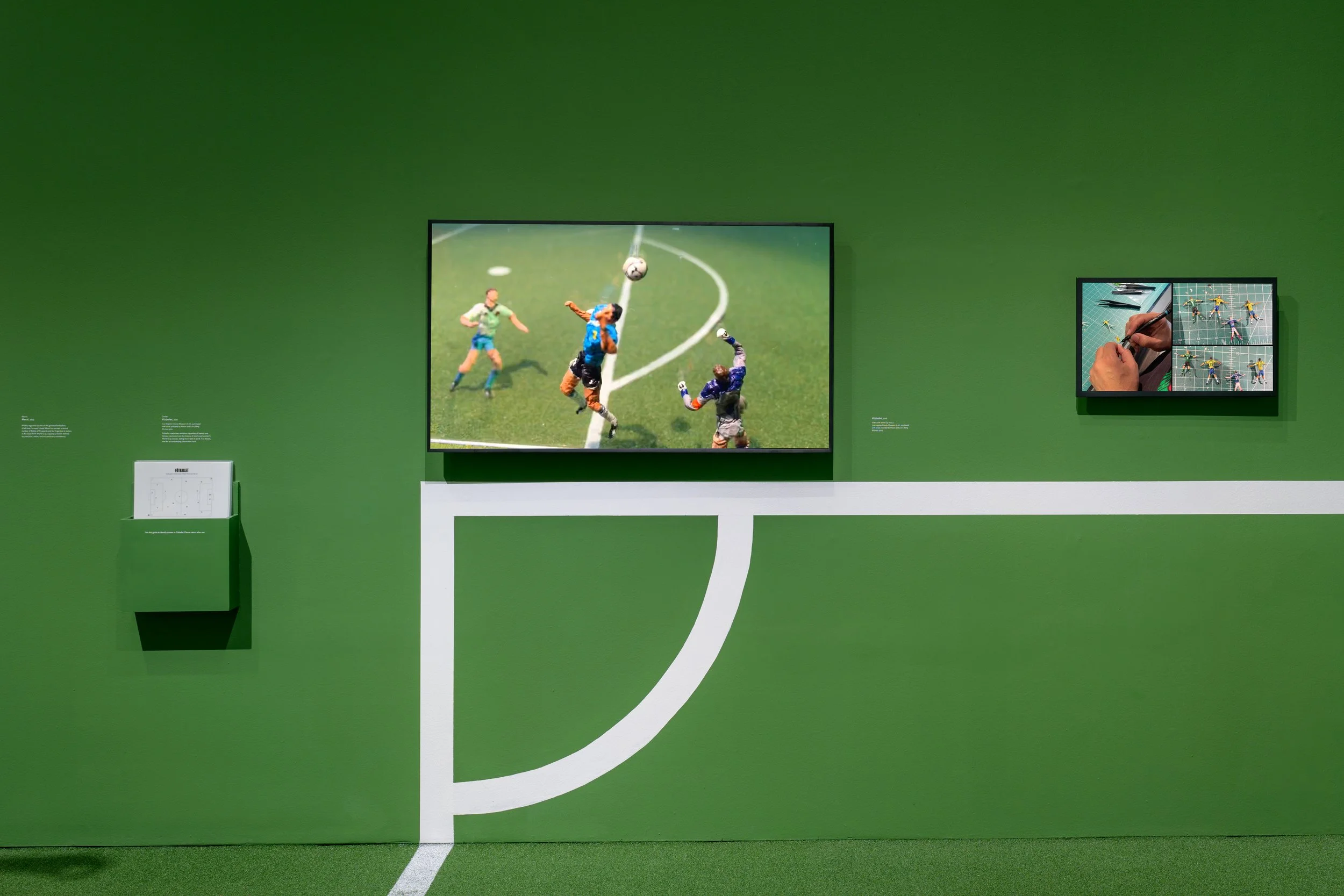
Installation view, Fútbol Is Life: Animated Sportraits by Lyndon J. Barrois, Sr., at the Los Angeles County Museum of Art, Feb 15–Jul 26, 2026, © Lyndon J. Barrois, Sr., photo © Museum Associates/LACMA, by Jonathan Urban
“Sports is the raw material. Art is where you get to the meaning.”
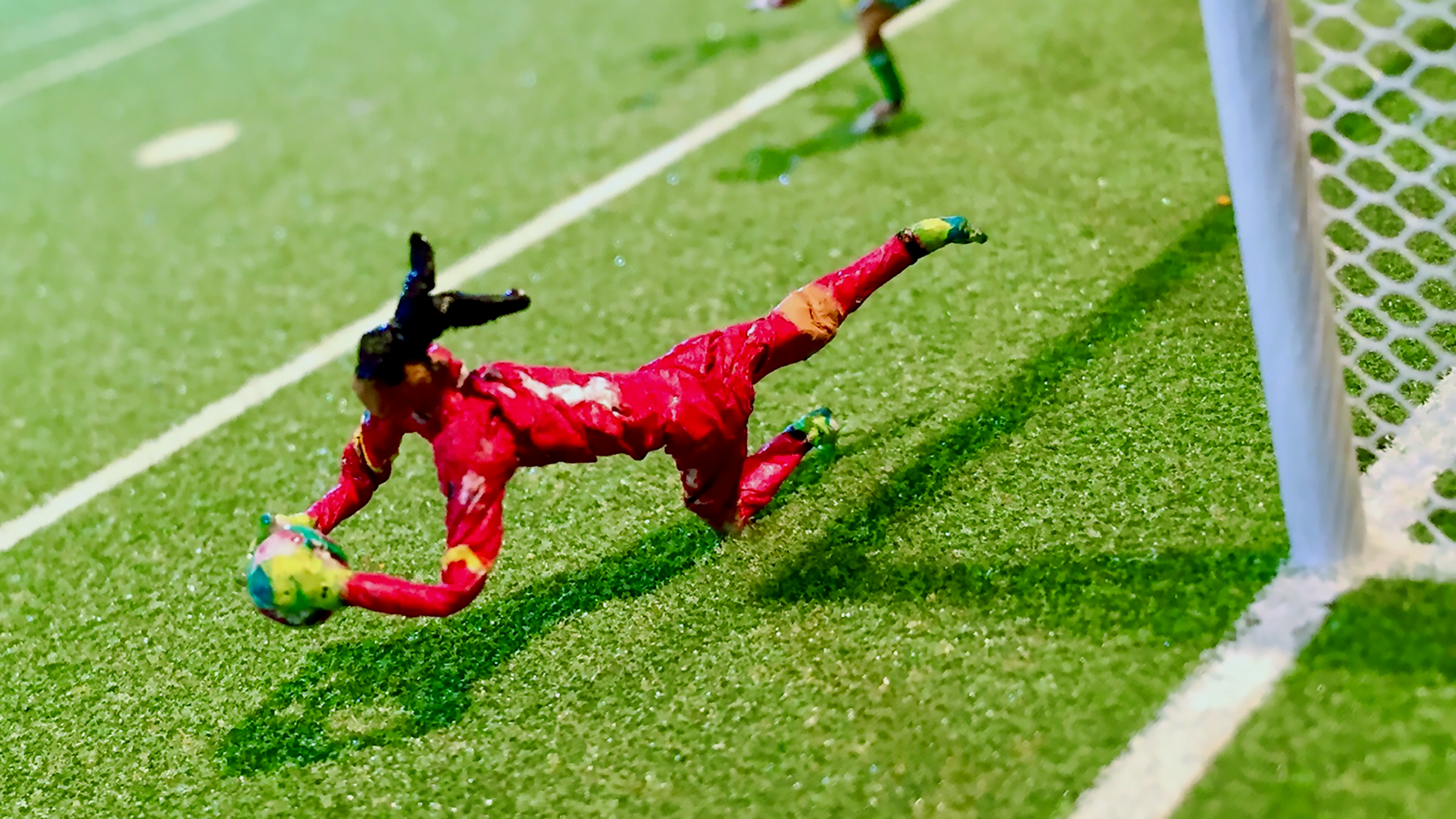
Installation view, Fútbol Is Life: Animated Sportraits by Lyndon J. Barrois, Sr., at the Los Angeles County Museum of Art, Feb 15–Jul 26, 2026, © Lyndon J. Barrois, Sr., photo © Museum Associates/LACMA, by Jonathan Urban
Tell me about the life-size figures.
For this show, I went all the way to life-size. I had many 9-by-18-foot gum wrappers fabricated. To give you a sense of scale, the original wrapper is about 1.5 by 3 inches, and when I sculpt from it, the figure comes out at average height of a miniature adult. That 9-by-18-foot wrapper, when sculpted down, gave me a kid-size figure. Each life-size figure took two and a half of those big sheets. You twist it, wrap it, shape it, build it up. And then all the details—the knee, the calf, the elbow, the wrist, the hair. Everything has to be accurate. People come in and immediately recognize the pose. They say, “That’s the moment he scored.” They know it.
How long did those take?
Five weeks each. Working at that scale was new—the physics changed. Small figures hold their poses with just the aluminum foil armature, but life-size ones need a reinforced skeleton and careful engineering.
Did any athletes come through the show?
Christen Press came in with her partner Tobin Heath. And Hope Solo—we shot a CBS Sunday Morning segment here. She didn’t know she was in two of the pieces. She started talking about the 2011 World Cup—losing to Japan in the final—and how even though it was heartbreaking, she felt humbled and genuinely happy for Japan because of the tsunami. And I’m sitting there knowing that moment is in the show, and she doesn’t know yet. I showed her, and she lost it. Then she started talking about South Africa 2010—a game she remembered vividly—and she didn’t know that was in there either. Those moments are something else. And a Senegalese guy came in who had actually been at one of the games. He said, “I was there.” That’s the thing about sports—it connects people across time.

Installation view (detail), Fútbol Is Life: Animated Sportraits by Lyndon J. Barrois, Sr., at the Los Angeles County Museum of Art, Feb 15–Jul 26, 2026, © Lyndon J. Barrois, Sr., photo © Museum Associates/LACMA, by Jonathan Urban
What is it about sports that keeps drawing you in—even going back to when you were a kid?
I just liked it. But as an artist, I was also drawn to the design—the color schemes, uniforms, logos, and helmets. People ask, “Why do you like a certain team?” Because I like their uniforms. And that’s valid—because they’re beautifully designed. Artists do that work, even if nobody’s thinking about it that way. Sports is the purest form of movement. Sports and dance are the purest forms of movement. Pure emotion. The highs and lows, and everything in between. And then the broader social and political context. The Black jockeys who dominated horse racing and were simply pushed out—because money came in, it got exclusive, racism did its work. The Negro Leagues. Women being shut out. You have to tell the whole story.
What about the relationship between art and sports historically?
There’s always been a connection—horses, athletes, movement. Museums, paintings, and sports have coexisted for a long time. You just find where you fit. And doing art about sports gives you access to the deeper things. Sports is the raw material. Art is where you get to the meaning.
Last question—what’s next?
I’m in conversations with the CAAM (California African American Museum) about an Olympics exhibition. Fingers crossed. And I’ve still got a foot in the film world—there’s a sci-fi feature project I’ve been developing with Lilly Wachowski’s company that I’ll direct. We’ll see where it goes. But the focus is here. The work.