
September 2026
Part Two
JOHN GIORNO:
NO NOSTALGIA
An interview with Anthony Huberman, Hanneke Skerath, and Carlos Valladares
What happens when painting becomes a venue for language? In conjunction with JOHN GIORNO: NO NOSTALGIA at the Marciano Art Foundation this conversation considers Giorno’s expansive practice across painting, poetry, sound, spirituality, performance, and film. The discussion brings together Hanneke Skerath, Director of the Marciano Art Foundation, Carlos Valladares, writer, critic, and curator, and Anthony Huberman, Art Director of Giorno Poetry Systems.
If The Relic Room, curated by Susan Aberth, in part one asks what happens when objects and symbols are removed from ritual and brought into the gallery, Giorno offers another possibility: language itself can move between venues, from the page to the canvas, voice, telephone, record, performance, and film. His work suggests that the gallery can function both as a container for art and as a site where language, image, body, spirituality, and lived experience are activated and put into circulation.
– Saul Appelbaum
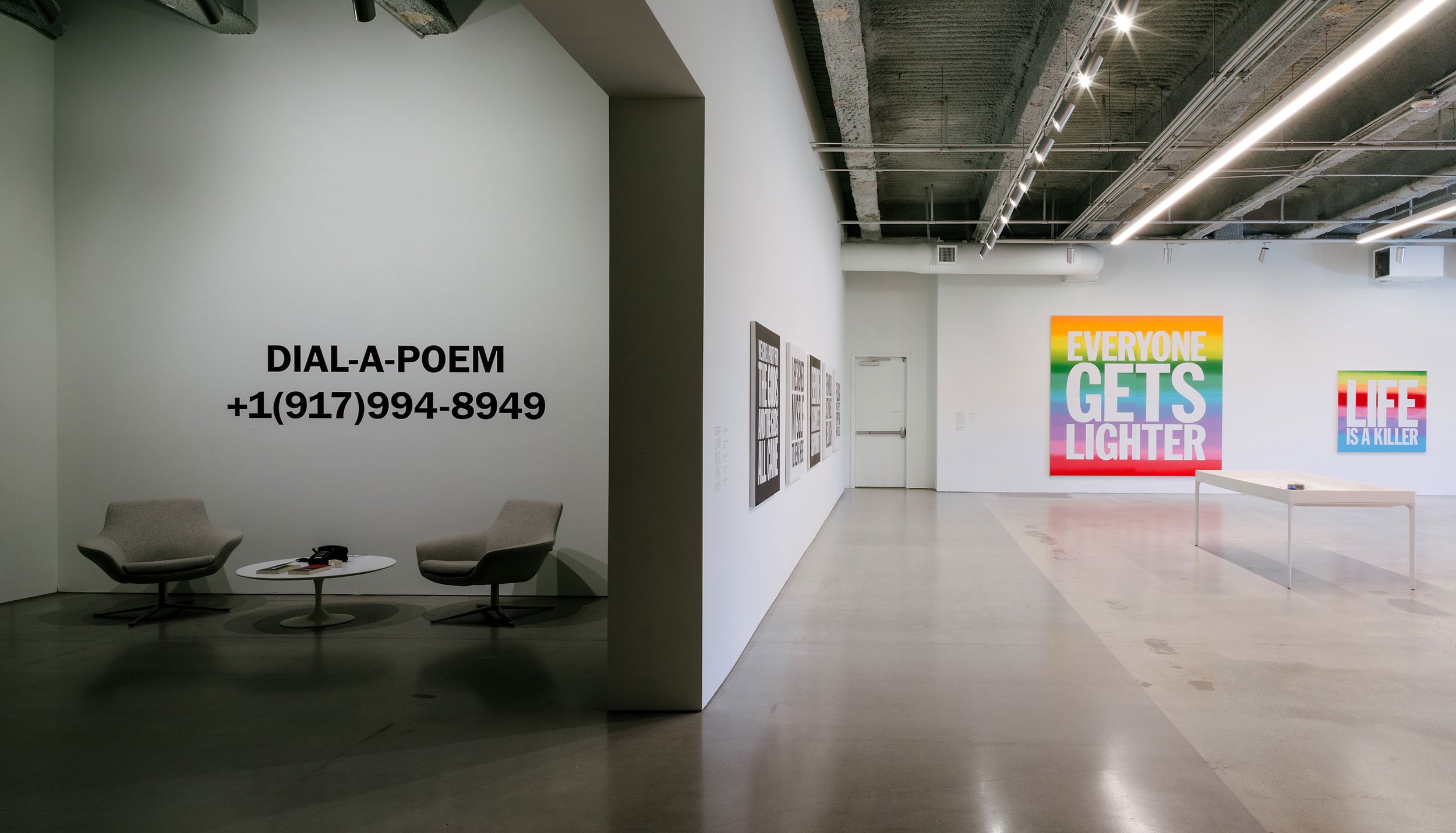
Installation view, JOHN GIORNO: NO NOSTALGIA, 2025. Courtesy of Marciano Art Foundation. Photo: Michael Anthony Hernandez.
Saul Appelbaum: Opening with some loaded questions, how do John Giorno’s words or phrases on canvas fit into the grand scheme of painting? Are they like a narrative character foil?
Anthony Huberman: John incorporates these phrases in a wide range of ways. One way to think about it is to find a way to allow language to exist outside the printed page or the traditional context where poetry usually lives. A word that I know John would use, and that I feel is useful, is "venue" instead of "context". John would always talk about these different venues for words and language and the natural habitat for poetry like the published book, the printed page, or a poetry reading in the coffee shop. John was constantly thinking about different venues for words.
It's interesting that you single out the paintings. To really push back against that question, the paintings on canvas are another venue equal to ink on t-shirts, ink on condom wrapper, words yelled into a microphone on the stage at CBGBs. All of those are venues for words to bump into the world, whether it's sung with a backing band of punk musicians, worn by someone on a t-shirt, or engraved on the grooves of a vinyl record, for sale at a record shop, heard over the radio, or painted in oil on canvas, using the tools that the visual art community uses, meaning oil on canvas hung on a white gallery wall. For John, all of those are venues. So it's not like one is more important than the other. They're all, ontologically, on the same page.
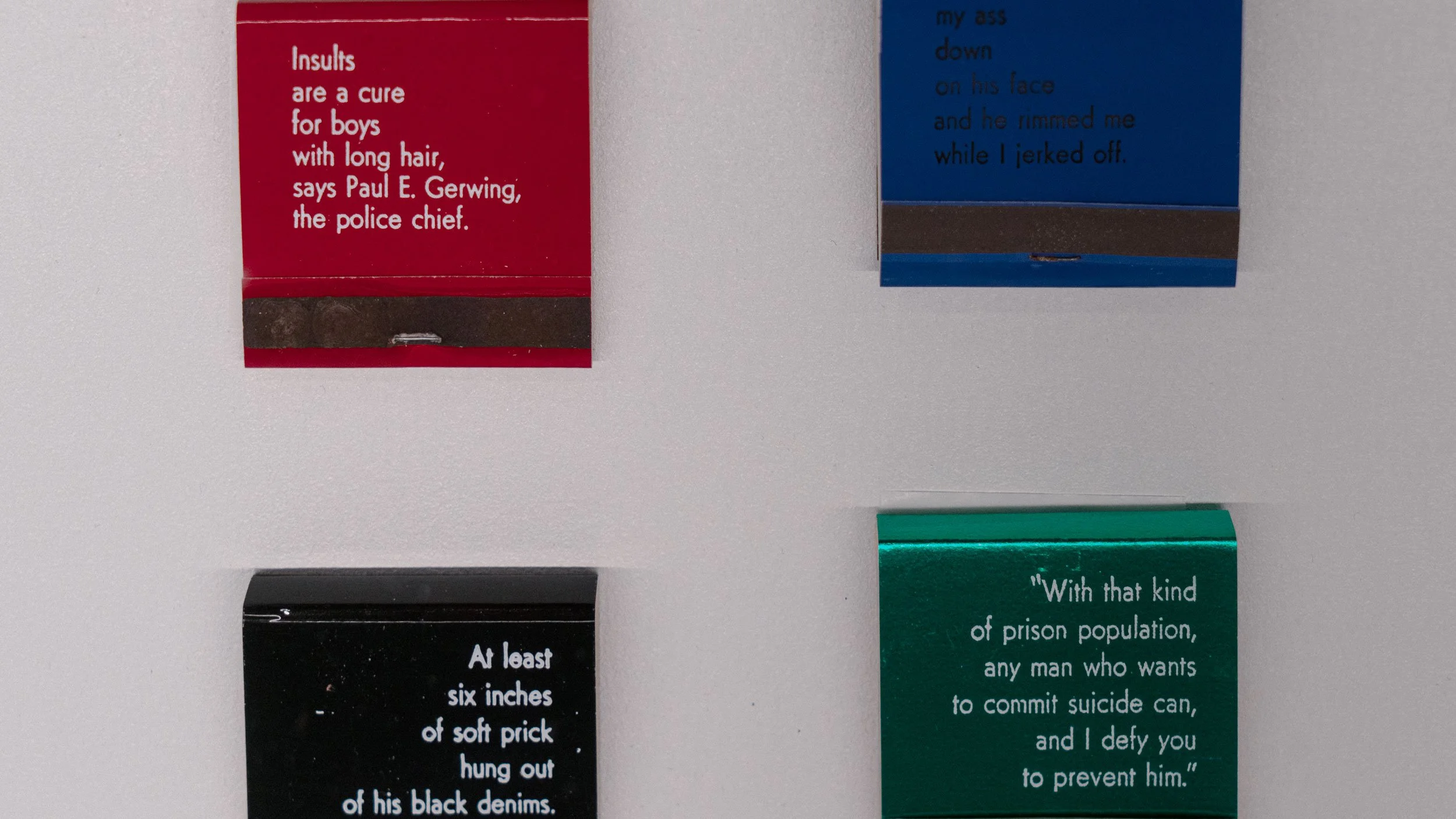
Detail, JOHN GIORNO: NO NOSTALGIA, 2025. Courtesy of Marciano Art Foundation. Photo: Saul Appelbaum.
SA: What about composition? What happens when a Giorno composition moves from the page to a painting? There are certainly differences.
AH: Definitely. There's big changes in how to visually compose the painting, how to put those words on a canvas. He's made a series of decisions that are standardized. He decided to use a square. It's almost as if he wanted to boil down painting as a venue, the concept of painting as a category, and to make that simple for language, no matter how many words, to figure out how to fit it within a square. And then there’s the font sizes. My take on the font sizes has always been that it’s John's way of visually translating what his voice does. When he performs, there's so much going on with intonation and emphasis on words. In the phrase ‘when I'm walking down the street,’ the word walking is louder and therefore would be in a bigger font.
You can say a word quietly, aggressively, seductively, violently, or hesitatingly. This is what John is doing when he performs his poems. There are many different ways in which language can be pushed, pulled, stretched, and condensed. In that performative sense, it finds its visual equivalent in the composition of a painting.
SA: I love that. To think of painting as a venue, as a denial of the primacy of painting, sculpture, and drawing while still tapping into conventions.
AH: It’s less about the individual painting and more about the system of painting. This is more in the lineage of conceptual art. These paintings come out of that rather than coming out of someone who's interested in what the form of paint does to a surface. It's more about how the venue of painting can be mobilized in the name of language.
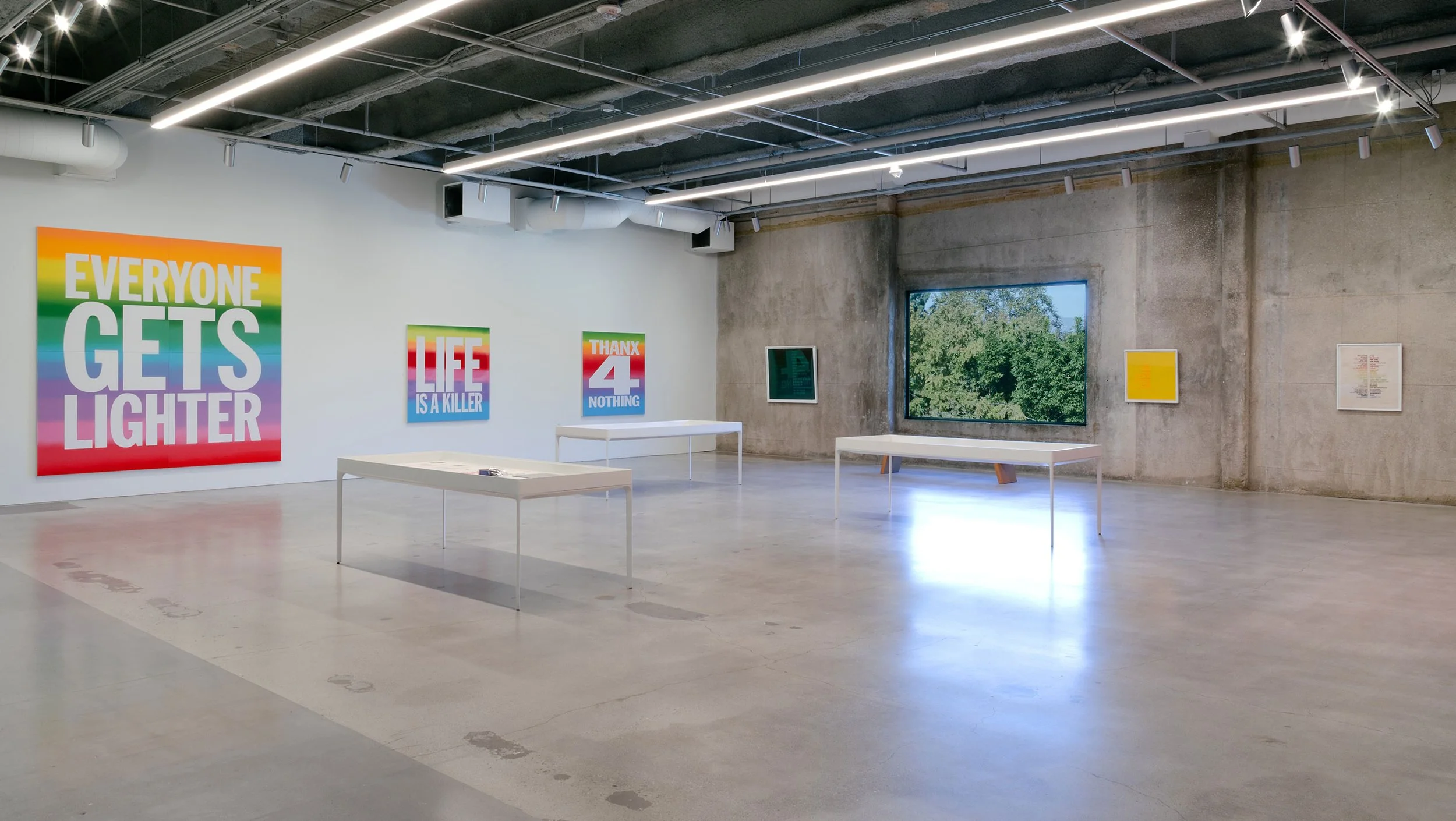
Installation view, JOHN GIORNO: NO NOSTALGIA, 2025. Courtesy of Marciano Art Foundation. Photo: Michael Anthony Hernandez.
SA: Giorno practiced Buddhism for decades. Is it apropos to think about the painted words as short, repeatable phrases, like mantras?
Carlos Valladares: Like, “Filling what is empty, emptying what is full”, things like that. From my understanding, his Buddhist and poetry practices were in parallel. He never claimed that he was making Buddhist poems or paintings. Giorno Poetry Systems were also doing essential work in the '80s around the AIDS crisis. All of these things, even though they were brushing up against each other, they're distinct projects. He would play with these notions of plentifulness versus emptiness, good versus bad, or extreme polarities in his practice. Wherever he made a venue, he always had this playful sensibility, questioning things that we've inherited as clichés while emphasizing the oddness of the word. In the early screen work you notice that it's almost like a direct translation of what he was doing on the page in the early '70s for his poetry books, versus later work with phrases like "Filling What Is Empty, Emptying What Is Full" or "Life Is a Killer," honing in on the font sizes as symbols of the voice.
It's like a purification process that happens on the canvas in his later work. It's less words, but there's more power to each one and what they’re doing. It’s also part of the Buddhist sensibility to consider the constant rush of life versus being carried by the word or being carried by a stream. He never tried to reduce this sensibility to a strictly Buddhist interpretation. But it's definitely there.
SA: There’s a punchiness to the phrases too. It makes them memorable. Something I may remember and repeat in my mind throughout the day.
CV: I describe them as koans in my exhibition text. They're like these little riddles that you carry with you throughout the day, and they get stuck in your head, like the phrase “everyone is a complete disappointment”.
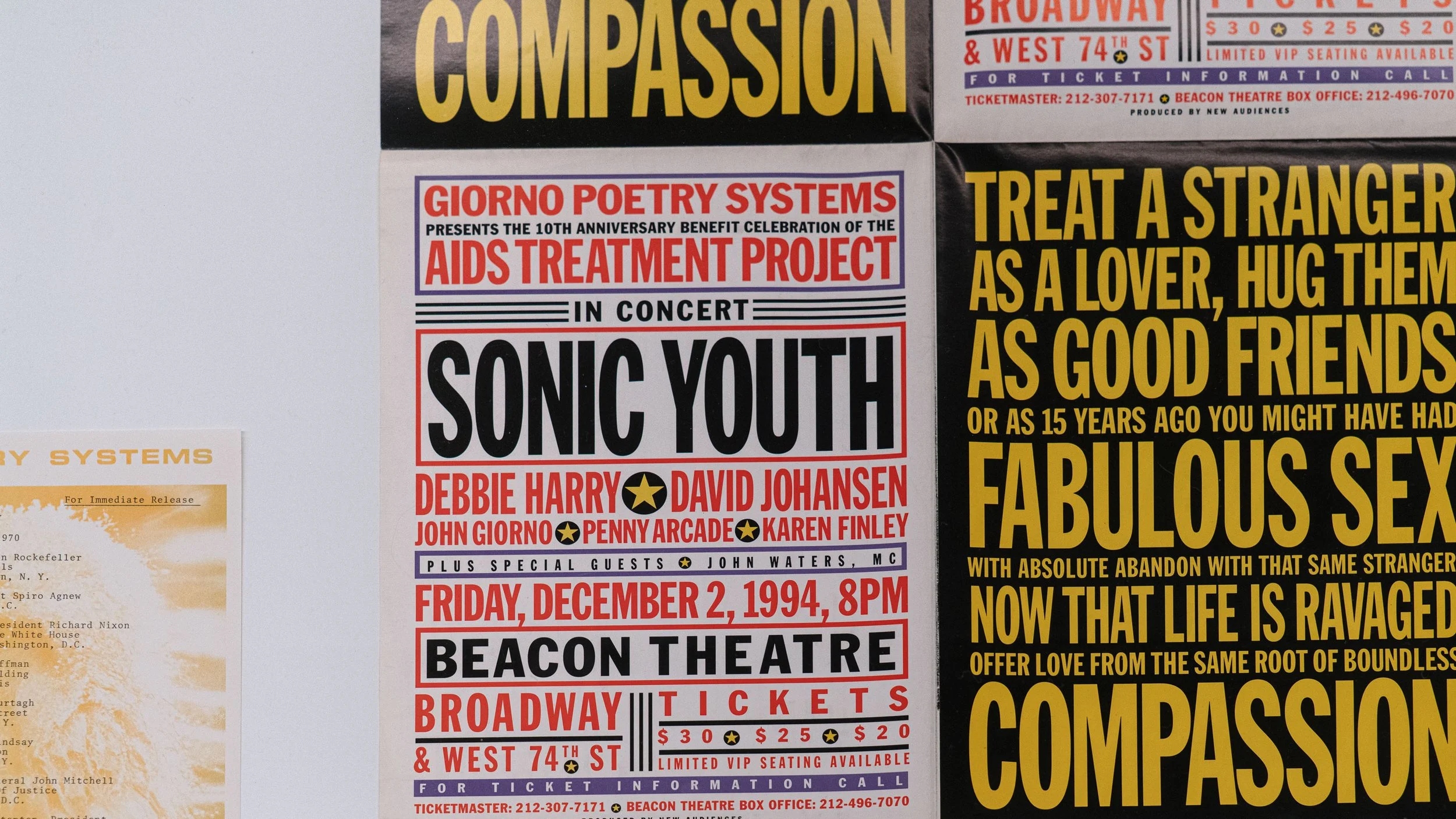
Detail, JOHN GIORNO: NO NOSTALGIA, 2025. Courtesy of Marciano Art Foundation. Photo: Saul Appelbaum.
AH: Giorno’s phrases “life is a killer” or “nothing recedes like success” contradict themselves. They come from this place of Buddhism, which is all about rejecting a binary. It’s the lesson that there is such a thing as life, and such a thing as death. Don't cling to one and try to avoid the other. Recognize that both are the case and be comfortable with the fact that they coexist. Life is a killer. It allows contradictory forces to actually coexist, which comes from a fundamental Buddhist sensibility.
Art historically, when you talk about repetition, your point about mantra and breath is completely valid. In the monograph that just came out, The Performative Word by John Giorno, the essay by Kyle Dacuyan explicitly talks about breath. The reason mantras repeat is that they're trying to sync with the fact that breath is a repeated bodily function. And so to tune into that, you repeat in line with your own body. All of this is coming about at the same art historical time period that Philip Glass and Steve Reich are playing with repetition, short loops, and phasing. This is all simultaneous. These people all talk to each other. Philip Glass has an intense Buddhist practice also, and still today. Laurie Anderson and Philip Glass serve as the artistic directors for the Tibet House US Benefit Concert. It is held annually at Carnegie Hall in New York.
CV: There's an early phase in his poetry which is his cut-up phase that is particularly pronounced once you see his later poems. In a way he's following Burroughs, looking at everyday ordinary realities like newspapers and advertising. It’s similar to J.G. Ballard. There was an interest specifically in the refuse of the daily that he then turned into poetry. It’s a particularly Buddhist way of looking at the world, not segregating between the high and the low, or between what is segmented as art and what is not art. That morphed into the work for records, performances, and then the paintings as a later instantiation. It's all part of different forms for the same kind of process.
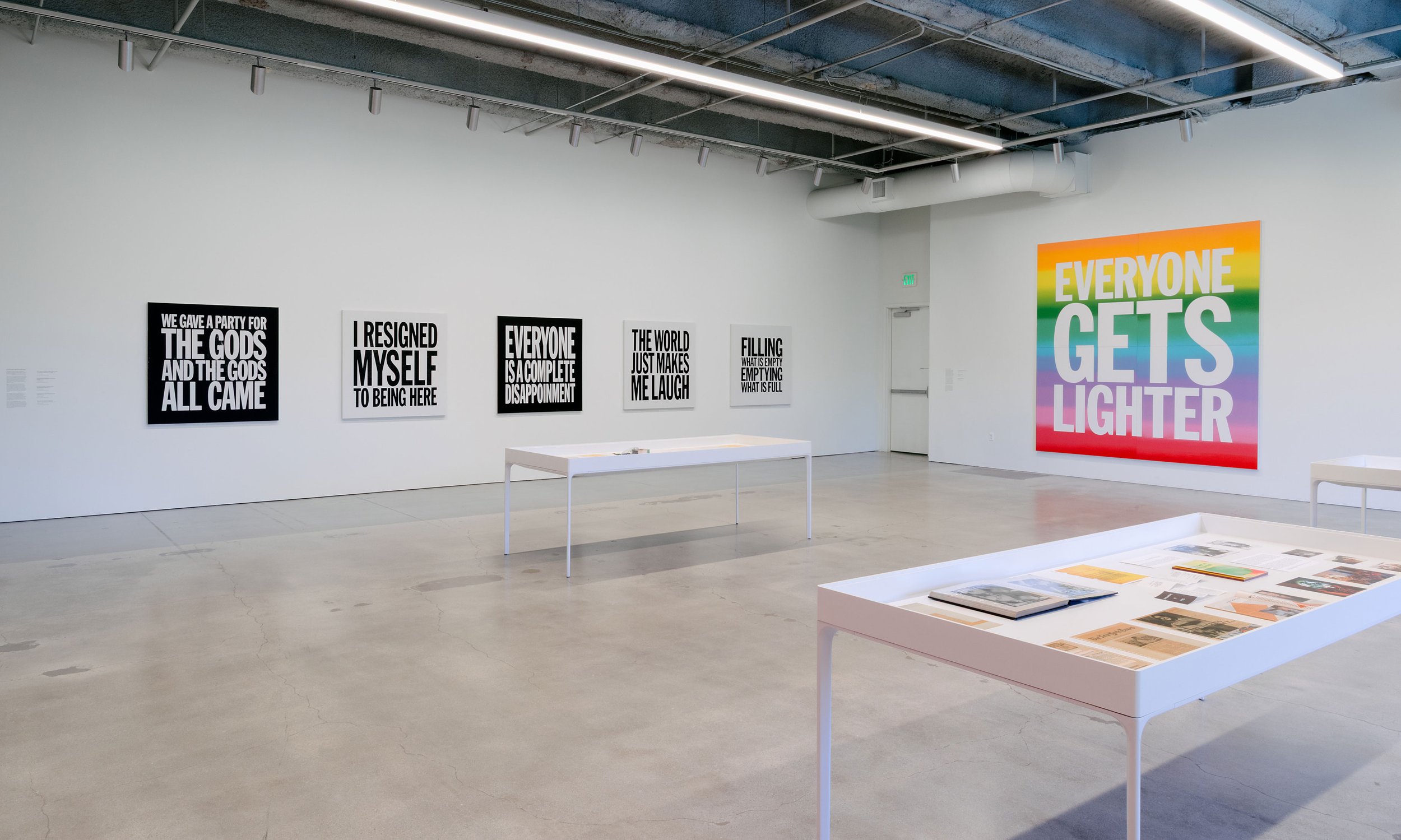
Installation view, JOHN GIORNO: NO NOSTALGIA, 2025. Courtesy of Marciano Art Foundation. Photo: Michael Anthony Hernandez.
SA: Recently, I’ve been thinking about Kandinsky’s Concerning the Spiritual in Art and asking the question where did the spirit or feeling go in abstract art?
Hanneke Skerath: In the context of the Marciano Art Foundation here, when I put together the Corita Kent exhibition I also always knew I wanted to work with Giorno. When Corita became a real show, I wanted to not counterbalance, but to supplement this with John, because I think Corita and John, however different the practices are, if you talk about feeling, emotion, spirituality, the way they live their lives, and celebrate, it’s a form of resistance. It's not all happy and beautiful colors because we ignore reality. We live in the darkness, especially Giorno, who was always so transparent about his struggles of just being alive. It’s the same for Corita too. Both of them, through their art practices, bring joy, but also connection, and being human on a very basic level.
They didn't need to package things. It's very refreshing, having Corita and John in mind at the same time. Now we shifted to Bruce Connor, but there's a similar kind of approach there with an attention to emotion, being human, relationships, and context. Spirituality for Corita was a means to get closer, while being rooted in the world. As a nun, you have to do a million things. She was overworked all the time. It’s the same with John. His life must have been so busy all the time, and most of the work didn't make any money. So there’s this idea of it being a labor of love. It’s such a beautiful connection.
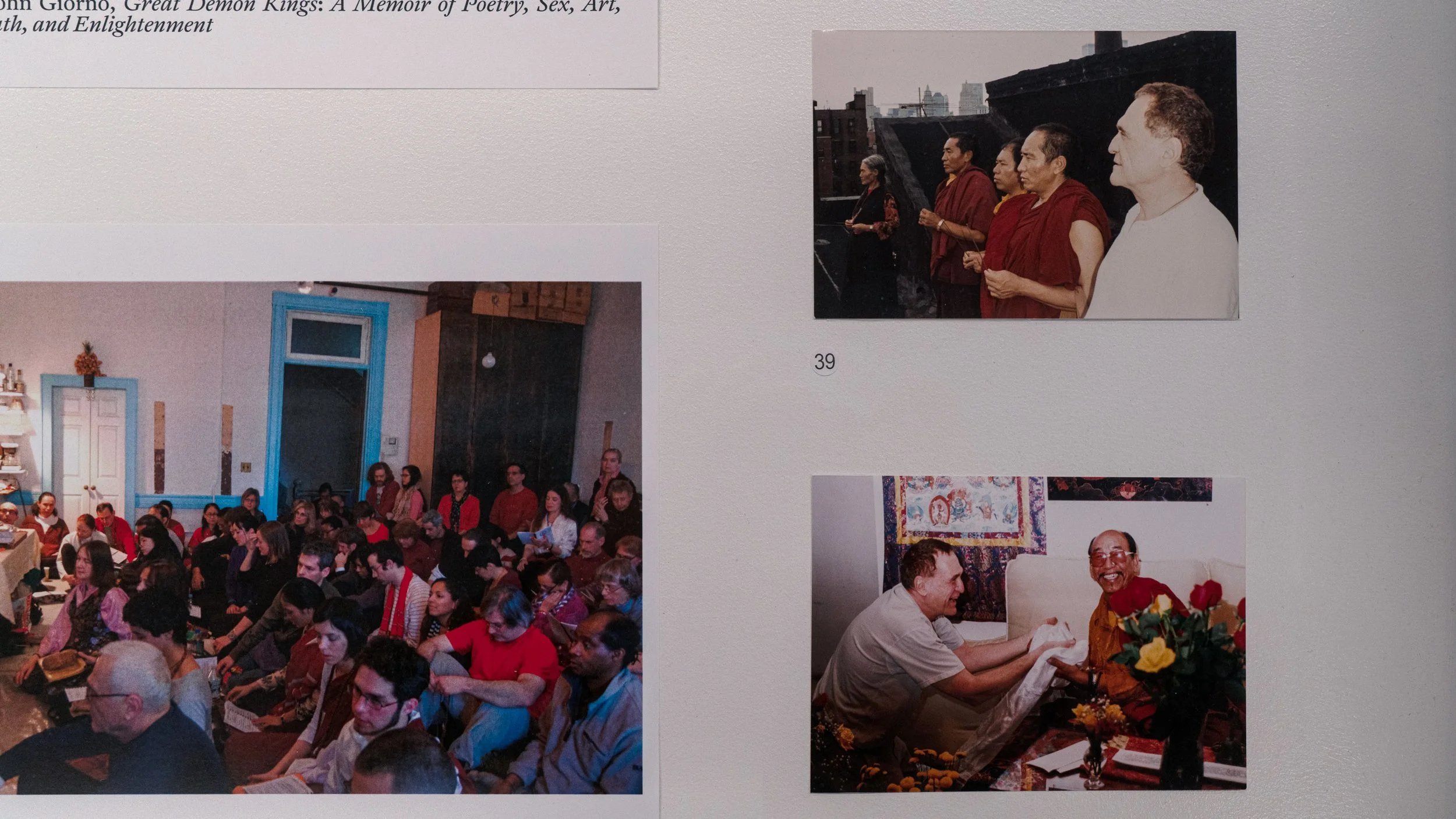
Detail, JOHN GIORNO: NO NOSTALGIA, 2025. Courtesy of Marciano Art Foundation. Photo: Saul Appelbaum.
SA: It's almost like a head monk sweeping the monastery.
HS: Yes. Who organizes the party? Giorno did the fire ritual, he organized the parties, and he bought the food. Who does all the fucking work to actually create these moments? Often, of course, it was women doing that for many of the artists. John was certainly that person, too, who created the opportunities for community and exchange.
AH: The combination of these two feels inspired. I was struck by how thoughtful, layered, and textured that combination between Sister Corita and John was. There's a great insight there that is really valuable for everything, with this connection to the humanity of it all and the people-ness of them. Who are they as people, and how closely connected is that to what it is that they made as cultural producers? Whether it's the spirituality of their being or their community focus. It’s important not to talk too long about John Giorno without mentioning the political side of the work. First and foremost is the LGBT activism. Remember that this was a time when other artists were as quiet as possible about their sexuality.
With John, part of the emotion is expressed in the questions, how can I be as loud about it as possible? How can I scream it into a microphone? What is the way I need to do whatever Rauschenberg would not? I disagree with my peers about this and want this prominently put out into the world. He was trying to make it as personal as possible.
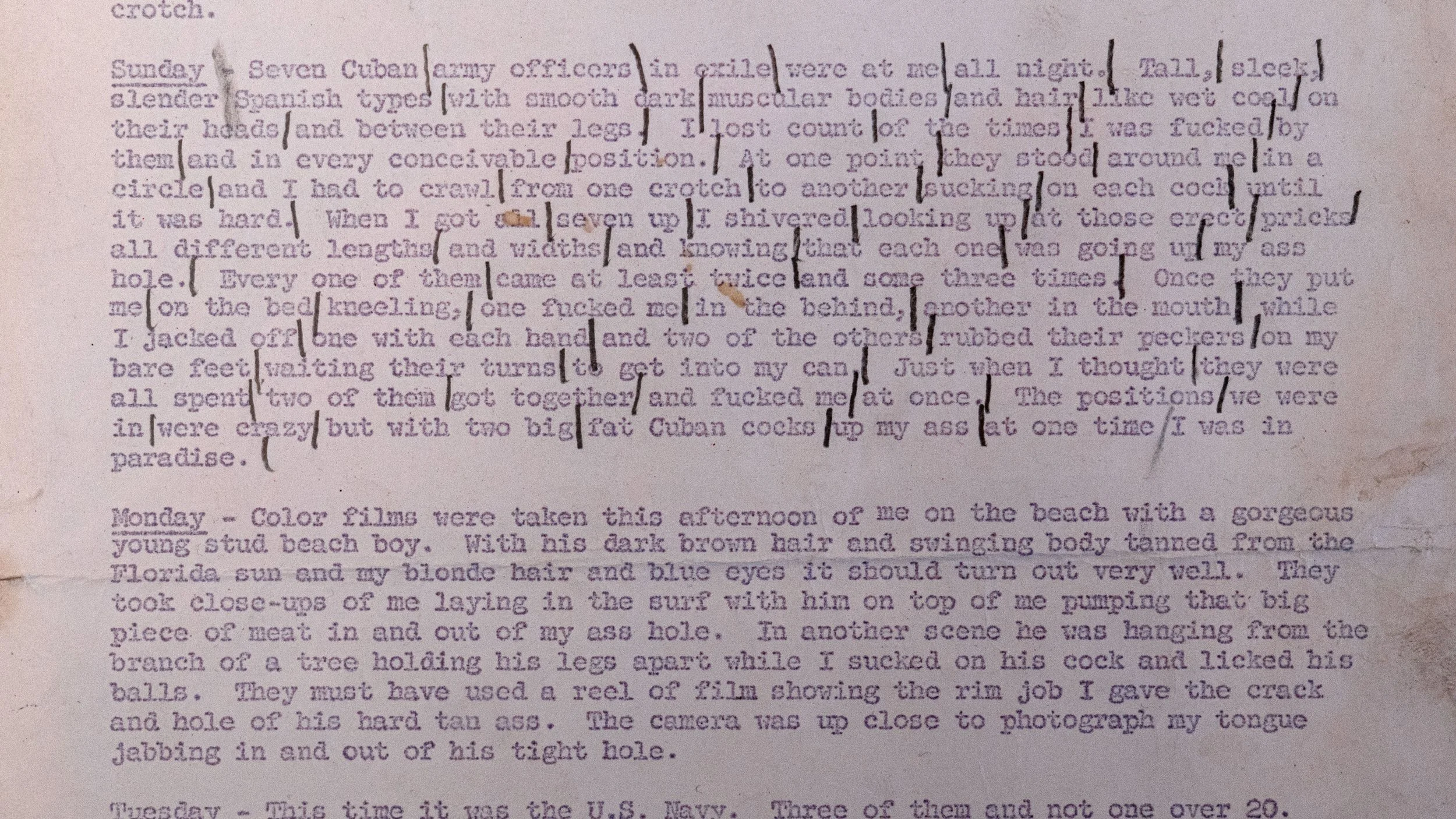
CV: One of his landmark poems is the Pornographic Poem, which is so explicitly gay. It's the imagery of it that he takes, in a kind of Rauschenberg style, in a comic sort of way, directly from the street.
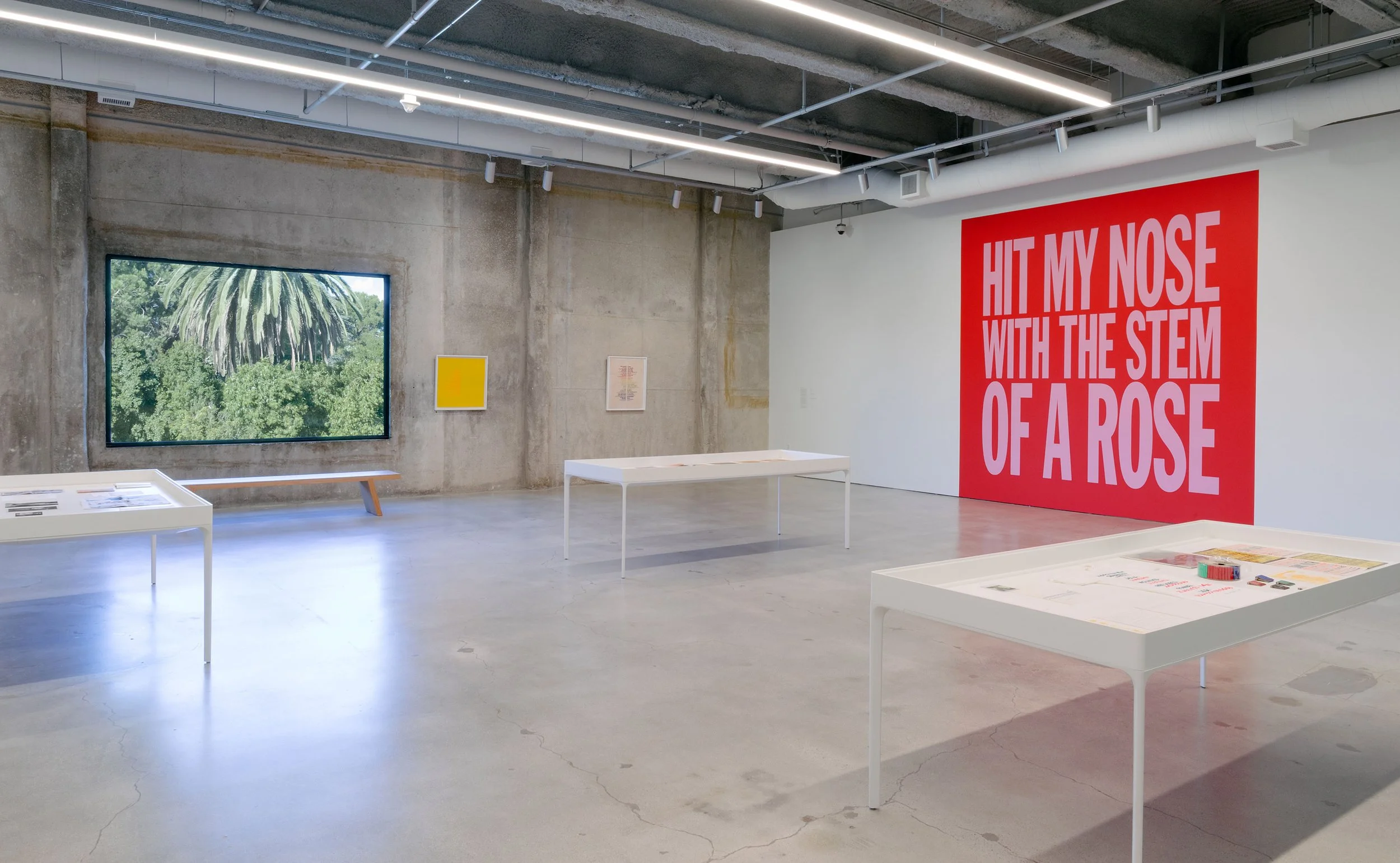
Installation view, JOHN GIORNO: NO NOSTALGIA, 2025. Courtesy of Marciano Art Foundation. Photo: Michael Anthony Hernandez.
SA: I’ve been studying screenwriting and marveling at how actors analyze scripts and bring them to life. I’ve also paused many times on Sanford Meisner’s quote that “acting is living truthfully under imaginary circumstances”. It’s fascinating to replace the word ‘acting’ with ‘art’.
Will you talk some about Giorno’s performance practice where the poems act as a kind of script and blur the line between truthful experience and constructed language?
CV: My mind immediately went to Warhol’s film Sleep featuring John Giorno. That may be the quintessence of truthful acting under imaginary circumstances because it is a performance reportedly six hours long of a man sleeping. Even this is not really what is actually going on there. First of all, there's no man there. It's a projection. Second of all, as is related in Warhol’s memoir, it took him about a couple of months to even create this fantasy because he didn't know how to use the camera. It’s touching to read those sequences and see Warhol trying to figure it out. He’s very distracted by the spectacle of this beautiful man in front of him, the camera going up and down, and you see a new awareness of how to look at and be with a body that’s modeled clearly in that film, as much by the conscious, non-sleeping Warhol as the unconscious, sleeping Giorno. Even though it's Andy Warhol's Sleep, with him behind the camera, it's obviously a collaboration between the two of them.
Detail, JOHN GIORNO: NO NOSTALGIA, 2025. Courtesy of Marciano Art Foundation. Photo: Saul Appelbaum.
CV: This gets to the truth of what a lot of filmmaking is at its core, especially with actors. It’s a collaboration, not just an imposition of an abstract idea onto actors that they are meant to parrot and embody. That's been the populist perception of it since the valorization of Hitchcock and Kubrick. There's a different form of filmmaking that people as diverse as Howard Hawks, Jacques Rivette, Roberto Rossellini, and Andy Warhol represent, which is more a collaborative open space where a figure silently pushes the proceedings, and it's not a hectoring force like Hitchcock or Kubrick. It's a collective performance, which also gets to the fact that Giorno’s poetry comes from performing it out loud. It's meant to be experienced with other people. It's meant to be in dialogue with them.
It's not just meant to be experienced in a T.S. Eliot way. This is something that hasn’t been written about in larger American literary history, and it really should be. To push how much Giorno did within the New York art and literary worlds to democratize poetry, truly democratize experience everywhere, and not only something that is rarefied in a poetry book or academic.
Installation view, JOHN GIORNO: NO NOSTALGIA, 2025. Courtesy of Marciano Art Foundation. Photo: Michael Anthony Hernandez.
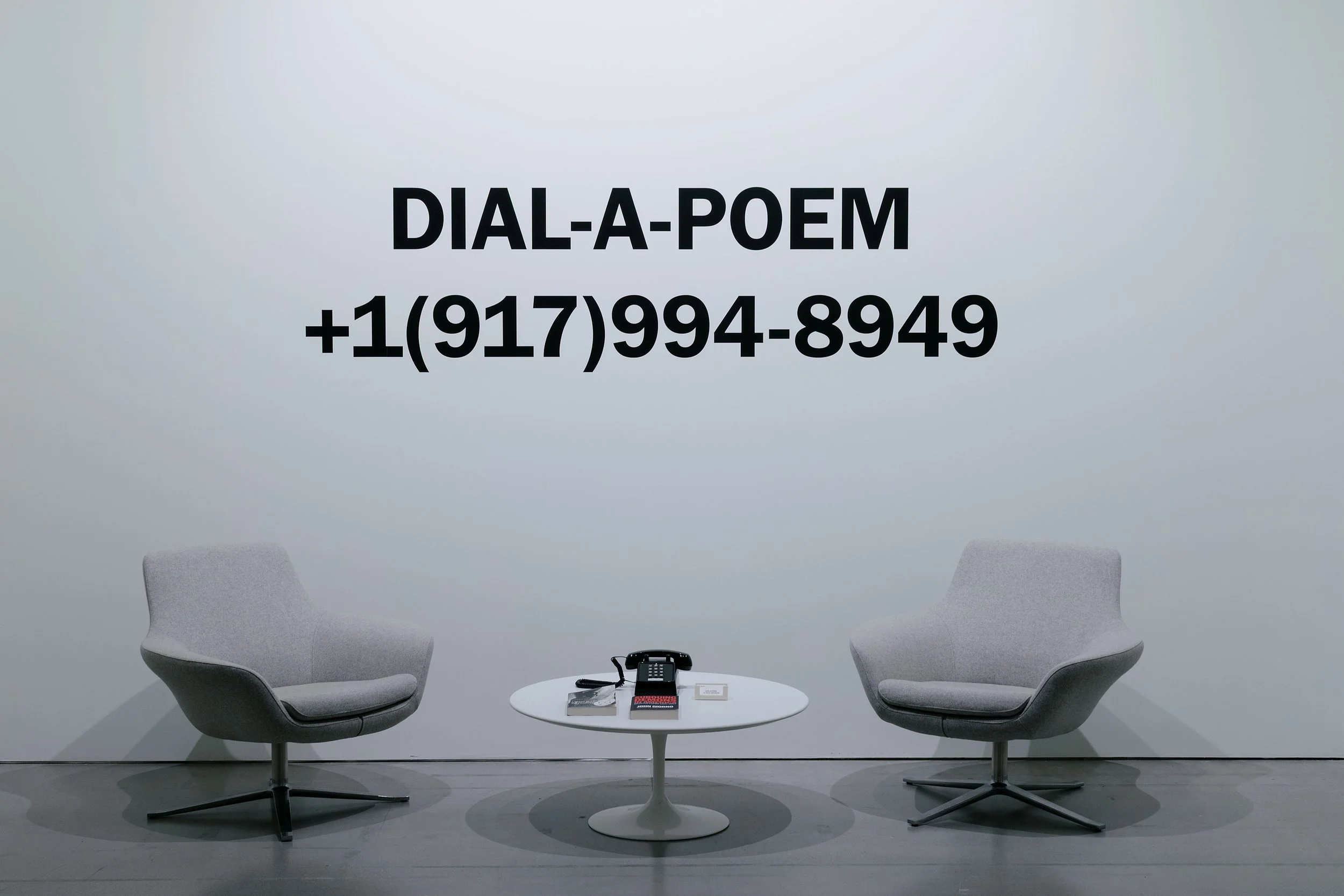
SA: Giorno’s Dial-A-Poem is a wonderful example of this democratization. I’ve been thinking about the Internet as something one may compose like an abstraction, where a painting becomes a node of meaning in a larger distribution composition. The entire thing is ripe with possibility to express emotions just as palpably with behind the scenes shape, line, color, and emotion. How might one think of that as a painterly or sculptural form one may layer and carve?
AH: The telephone was another venue for Giorno. A very effective one at distribution, wide distribution, and one that's part of everyone's home already. It was a way to incorporate poetry into everyday common acts rather than something rarified. Another aspect of this was radio. The reason Giorno made a record label was not actually to start a record label. One could distribute poetry even more widely than through the telephone by getting it on the radio. The only way to get on the radio was if a DJ received a record in the mail. The only way to do that is to make the record.
The Internet does fall into this. We're using it related to Dial-A-Poem at Giorno Poetry Systems. We lean into the Internet and also away from AI and an algorithmic logic of data sharing and consumption. In that model, you're getting something that an algorithm wants you to get. With Dial-A-Poem online, you still get a randomly selected recording. You’re going to get Patti Smith one time, and next time you call, it's going to be William Burroughs, not because of your previous call history, or not because it's harvested from something that you like. None of that is relevant. There's an insistence on keeping to the telephone and a random shuffle experience that people enjoy. Surprise comes from it without the preference harvesting that the Internet brings with it.
Another way we're distributing Dial-A-Poem on the Internet is through language randomization. Phone numbers have a country code. The Internet version of Dial-A-Poem is the only place where we can ignore the country. We’re exploring voice in all of its many shapes. Whether it's the shape of the Thai language or the shape of Italian, that’s what’s happening on a sculptural level.
If these are public artworks, a public piazza, or a big altarpiece to the voice as it is, as a muscle, an instrument that can express art and poetry in the world, then let's celebrate it in all the ways the voice can sculpt language.
