
August 2026
The Only True Protest Is Beauty
Fondazione Dries Van Noten
An interview with Ann Carrington
By Camilla Boemio
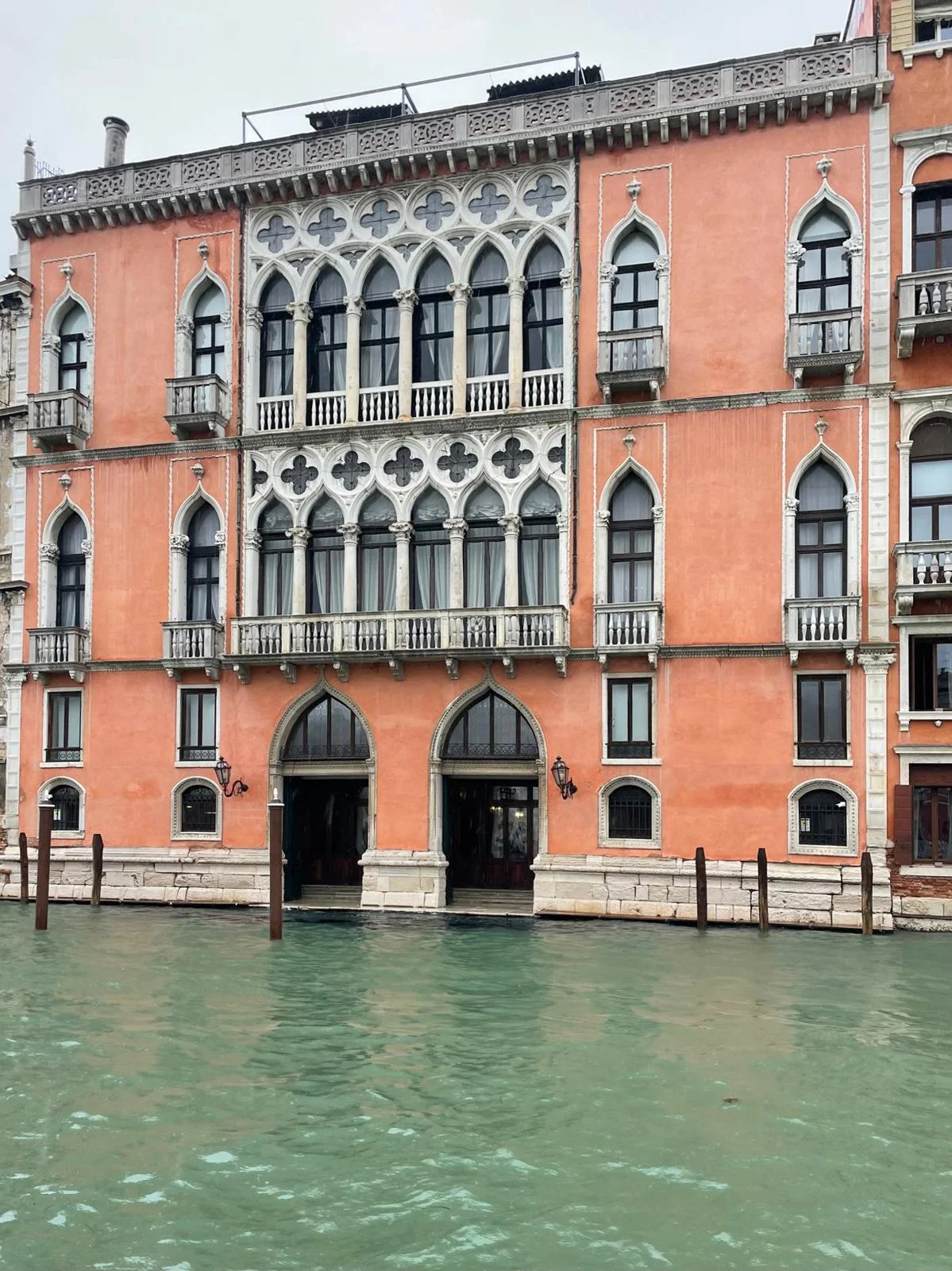
Fondazione Dries Van Noten at the Palazzo Pisani Moretti
There is a different set of rules at play here which I appreciate. The exhibition has been put together by a maker and so has a soul quite different from a museum exhibition which are primarily curated by folks who have studied art curation or museum studies. This exhibition shows that it’s possible to put things together in a space because they are, say, the same colour or because you can sense a commonality in the form or because you feel a room has a special atmosphere which you can sense in the exhibits too. You can throw away the museum rules of chronological order if you so wish. This is what makes this exhibition so exciting and energizing. That said, this approach needs to be in the hands of a master. Dries has an incredible eye and an innate understanding of the objects he has selected, their relationship to each other and to that of the historic Palazzo. The exhibition has the feel of a giant abstract painting where all the parts correspond to each other The colours,textures, meanings and intentions sing bringing with it an air of mystery.
The Only True Protest is Beauty bucks the trend of only showing established artists by including fresh new talent - relatively unknown creators that sit alongside the known and celebrated, treating them with equal regard. I really like this confident curational approach - a show that trusts its own judgement
At the Palazzo Pisani Moretti you can feel Dries touch in every room. There is a heartfelt direction, a human connection and passion which like an invisible motor propels you from room to room on a journey of exploration.
This exhibition treats craftsmanship as a language of expression and a conduit for emotion, deliberately moving beyond the boundaries of traditional disciplines. Works seem to respond and delight in one another and to the building itself – its ceilings, frescoes, and ornamental details, the Palazzo functioning as a participant rather than a neutral container.
— Camilla Boemio
Camilla Boemio: How are you inspired by spaces that reflect the influence of their surroundings: local history, architecture and socio-economic conditions?
Ann Carrington: I am interested in objects and the stories they tell. All objects are saturated with cultural meaning and as an artist I feel compelled to explore, unravel and investigate the stories within. It doesn’t matter to me if it’s a spoon, a safety pin, a Roman villa or a London nightclub. The interest and approach is the same.
When making the pieces for the Palazzo Pisani Moretti I had to consider its extraordinary heritage. The palazzo is a building that has been accumulating beauty for more than 500 years, a landmark of Venetian Gothic architecture. The frescoed walls already speak, the stuccoed ceilings and terrazzo floors have opinions, and the Murano chandeliers tell stories. The sculptures that I made for the Palazzo enter into a dialogue with centuries of Venetian artisans.
Ann Carrington, Persian Slipper, 2026, Silver, nickel, and steel plated cutlery. Courtesy of the artist.
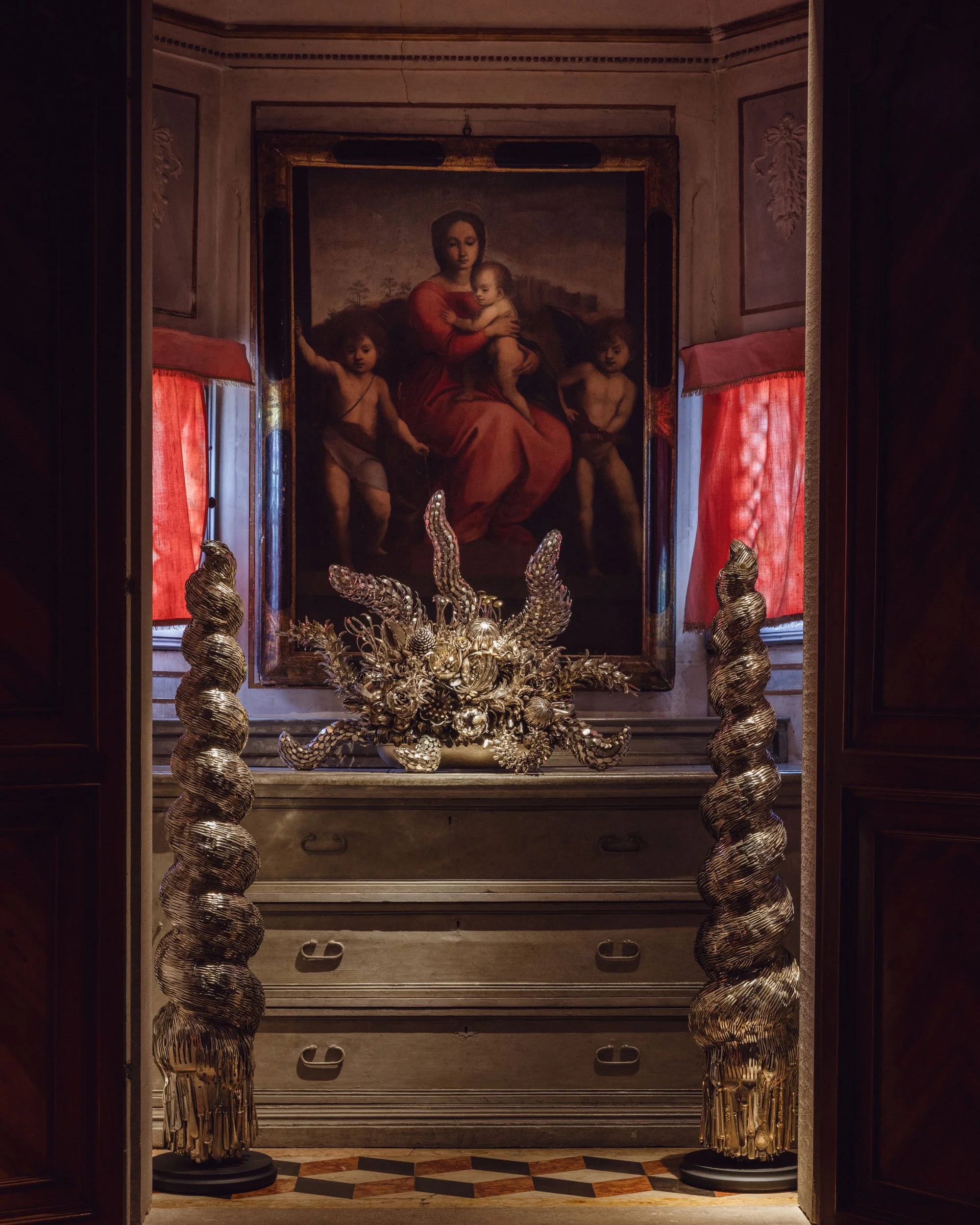
AC: Another element to consider regarding the building was that the artworks were to be sited in the historic Chapel at the very top of the Palazzo (so situated to enable easier access for Holy Spirits to the Heavens).
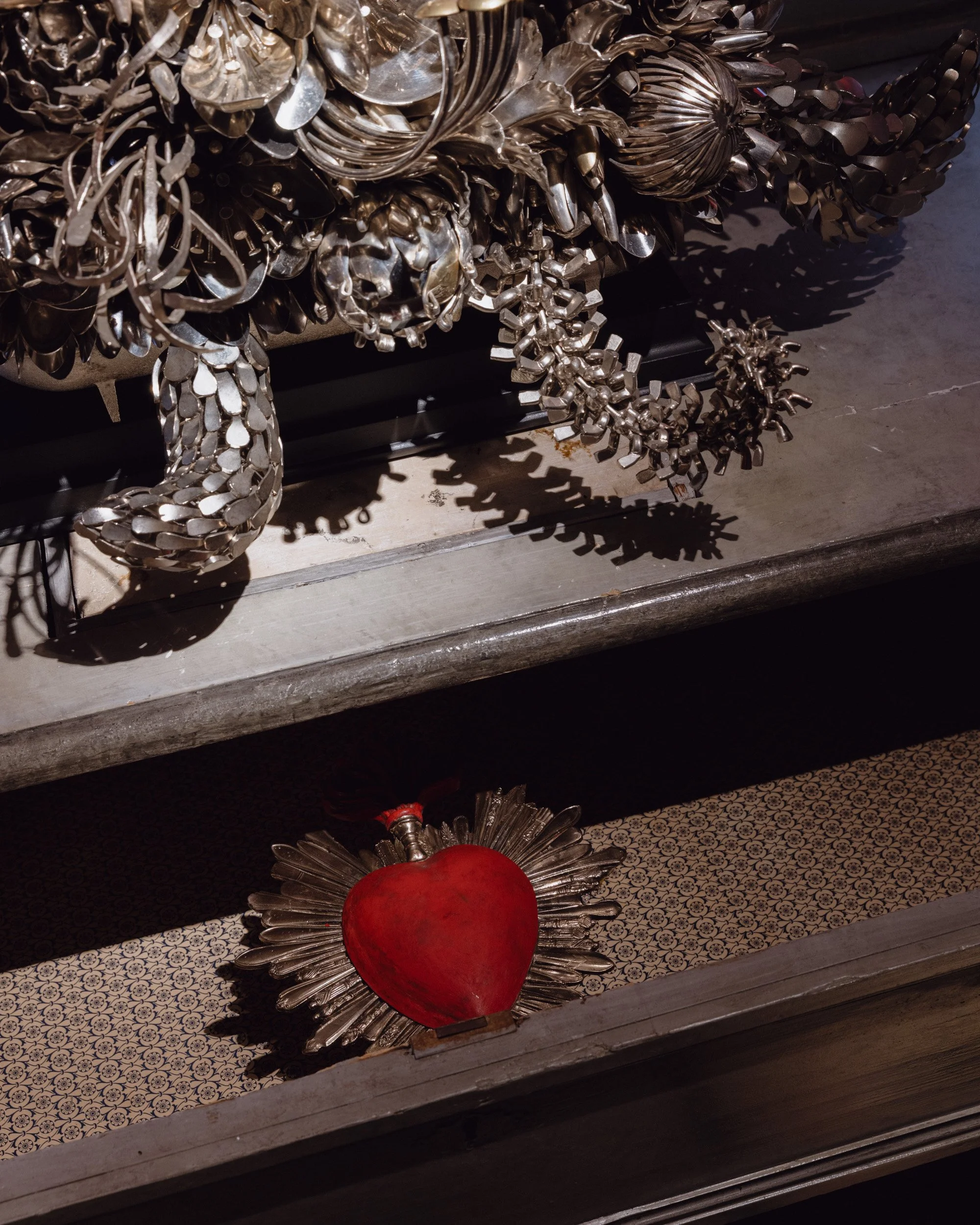
The first piece I made was for the shrine, to be placed under the watchful eye of the Madonna and Child. I sculpted a rich Vanitas bouquet of flowers fashioned from nails, whisks and cutlery, everyday objects which I bent into new life. My intention was to make it look and feel like it had simply slipped from the Nature Morts canvases that surround it and onto the alter where it had always belonged. I think it worked.
To stand guard protectively either side of the bouquet I built two totems from twisted forks, a gentle nod to the Solomonic marble columns, that fantastic feature of so many Venetian churches, their cork screw shafts symbolising the Holy Ghost’s ascent to heaven. Just above the totems to the left I placed a red heart pierced by blades, a sharp (!) reimagining of religious iconography, a heart so full of love it is actually bursting.
Similarly, the sculptures I made for my solo show ‘Interventions’ at Cheekwood House( Nashville 2022) were a direct response to the building and its layered history. Cheekwood House was/is one of the finest examples of The American Country Place Era, built in 1929 as the home for Leslie and Mabel Cheek – it was full of Great Gatsby attitude and Tennessee swagger.
The exhibition I put together told the story of the Cheek family, through domestic objects familiar to the house such as silver flatware, fancy goblets, serviette rings, embossed tureens, even horse shoes.What I liked about these objects was their suggestive histories and associations which I was able to explore to give them new meaning as sculpture. In their new formations they revealed a fresh narrative – my story of Cheekwood.
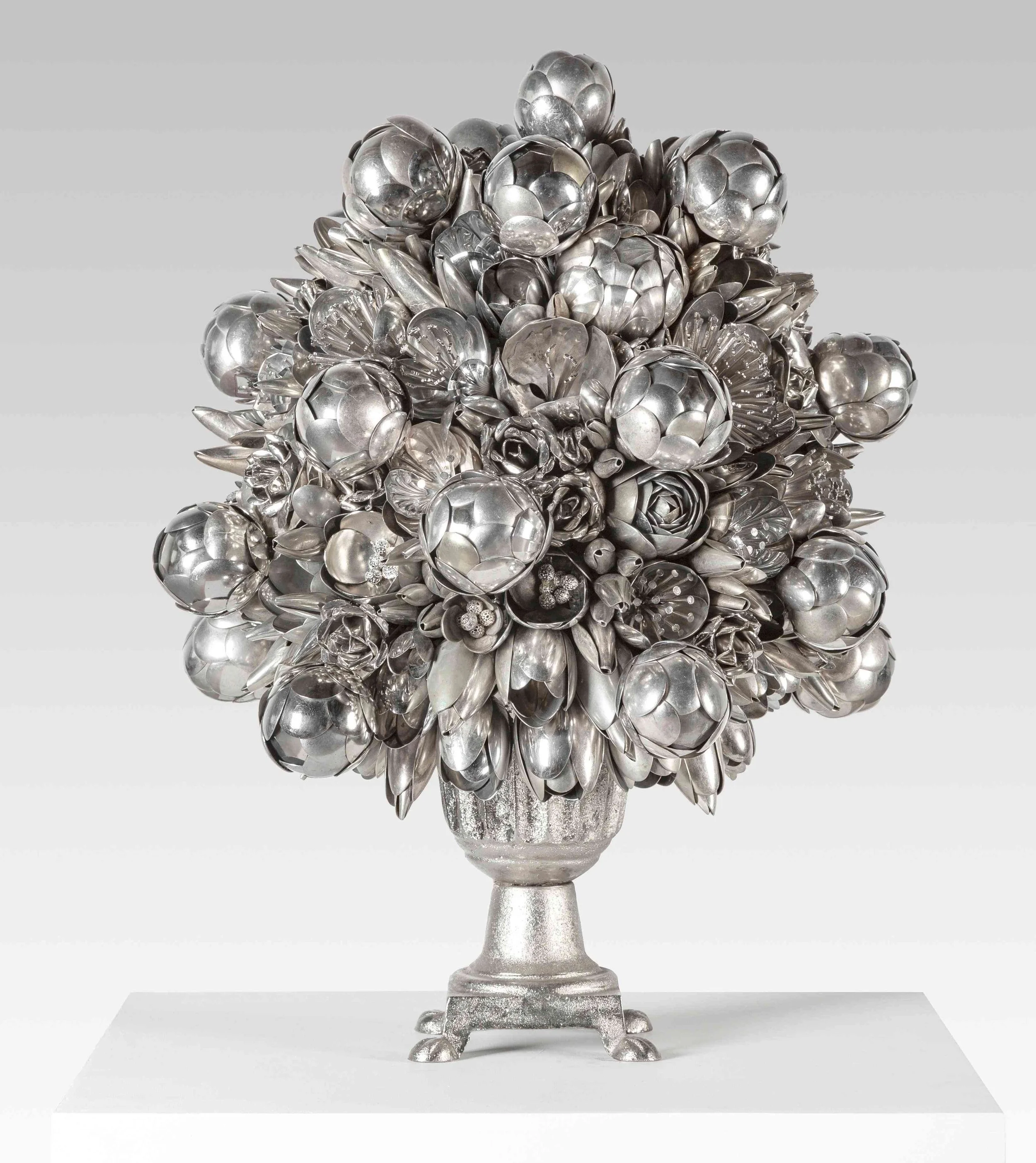
Ann Carrington, Japanese Snowball, 2020, Silver, nickel, and steel plated spoons. Courtesy of the artist.
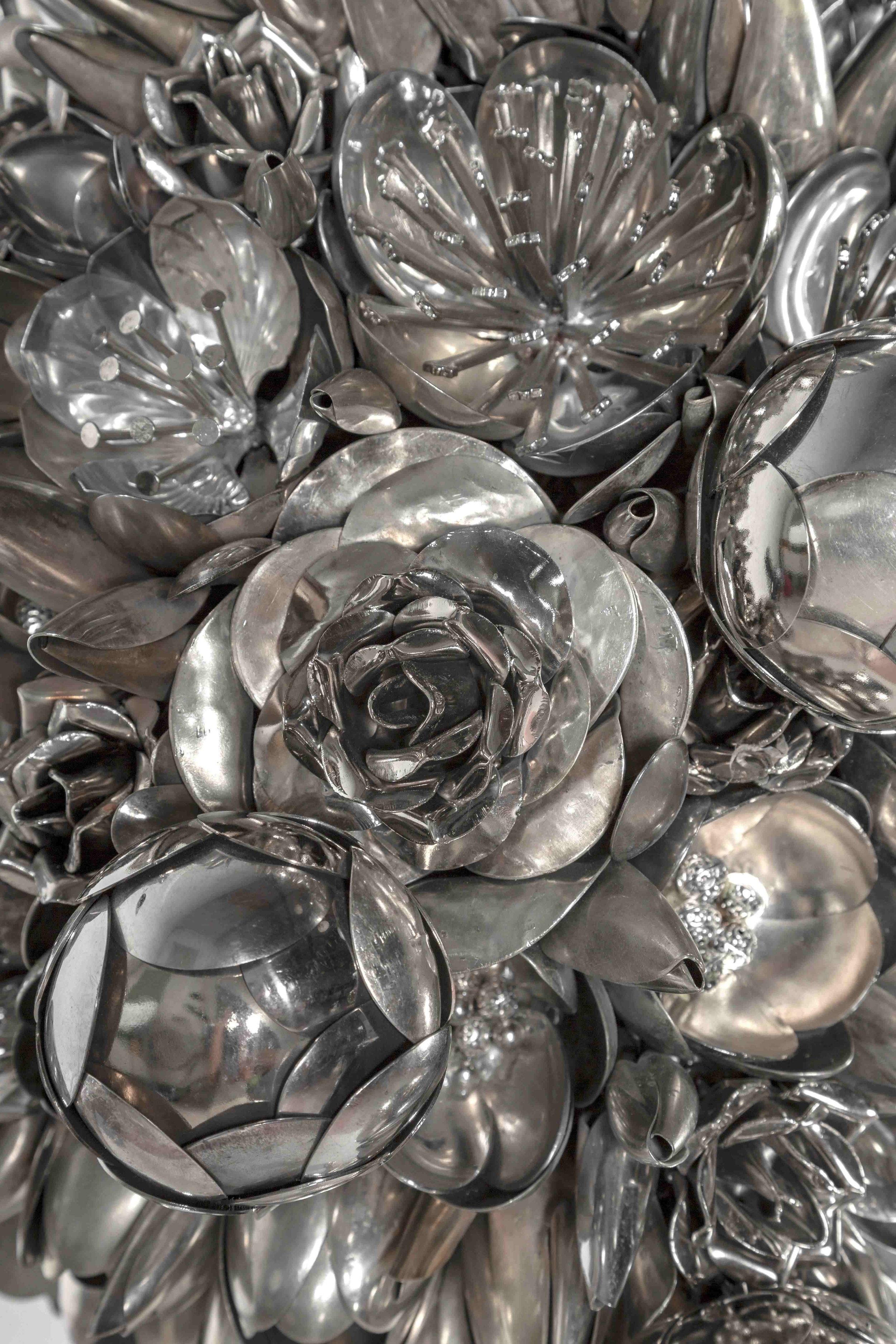
CB: Expanding a notion of beaut your artistic practice uses recycled and unconventional materials. Will you tell more about it?
AC: Through my art I aim to transform ordinary commonplace objects into the extraordinary, the beautiful even. I’m aiming to bring attention to and celebrate the everydayness of modern life to something that is often overlooked in our fast-paced society of mass production, thus revealing the histories and stories hidden behind mundane objects. Regurgitating the detritus of modern life is my modus operandi. Humdrum objects like knives and forks, barbed wire, pins and paintbrushes come with their own ready made histories. Materials are merged with form to tell a story through familiar objects.
I am often drawn to art history - a classical motif, such as a cornucopia that I feel is ripe to be dragged kicking and screaming into the 21st century! In classical antiquity, the cornucopia was a symbol of abundance and nourishment, commonly a large upturned container overflowing with produce, flowers or nuts.
My cornucopia borrows from this motif and reinterprets it utilising contemporary objects – knives, forks, nails, wingnuts etc. When I was making ‘Moonflower’ [see picture] I was referencing the classical cornucopia motif but I was also looking closely at Grinling Gibbons, the celebrated 17th century woodcarver, famous for his sculptures of cascading garlands and fruit. I think when you know this, it is quite apparent in the finished piece. So there’s a lot of history packed in here while being viewed through a contemporary and off kilter lens!
CB: The soft silver teaspoons are just right for the delicate rose petals.
AC: I remember that there was a pile of old spoons thrown in a haphazard heap in the corner of the studio. I spotted them out the corner of my eye and it occurred to me how much they looked like petals. This was when I first started working on the vanitas bouquets. I soon discovered that each spoon is made from a different metal. Soup spoons, it turns out, are usually silver plated nickel and the metal is softer and easier to bend so lend themselves perfectly to delicate curled rose petals.
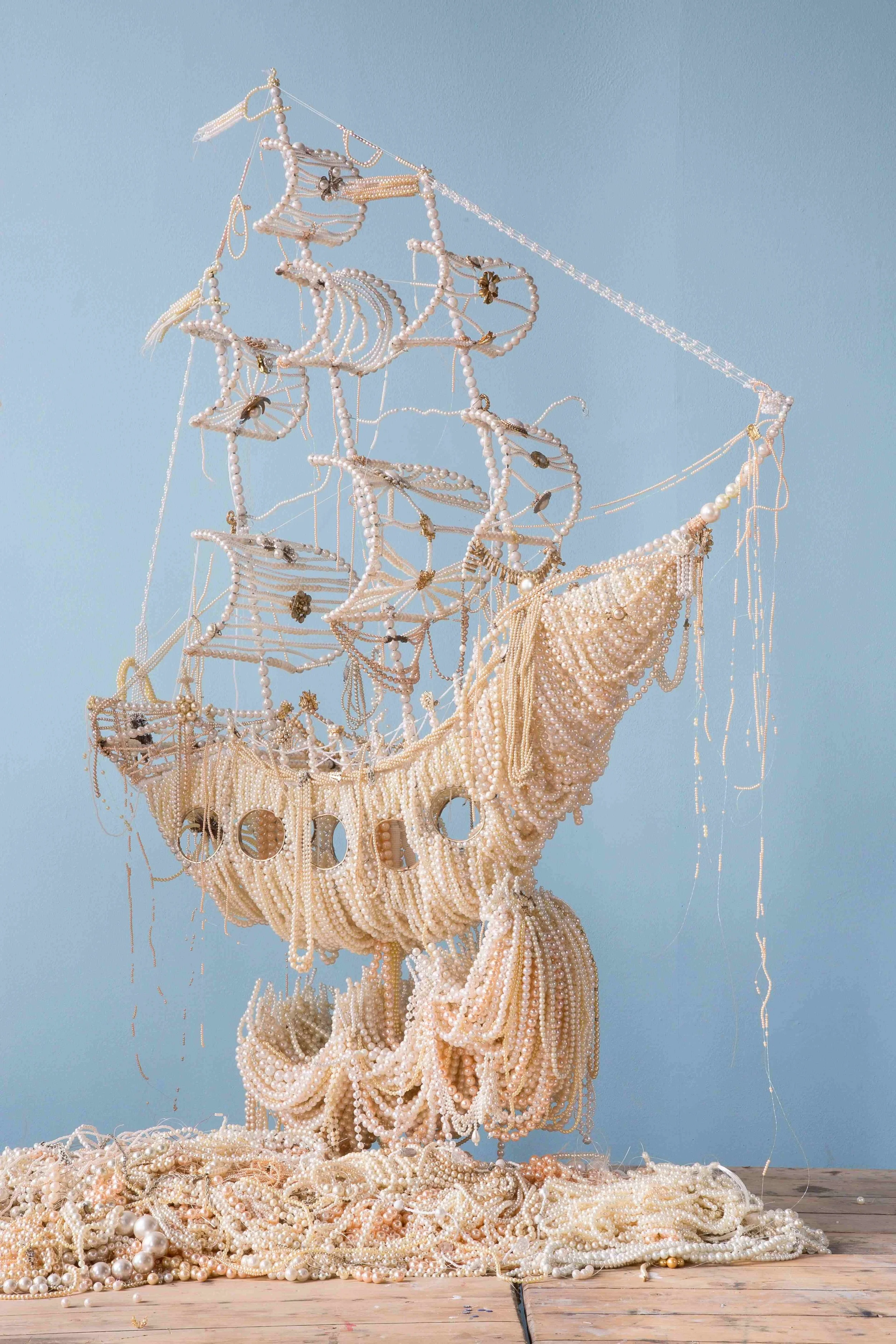
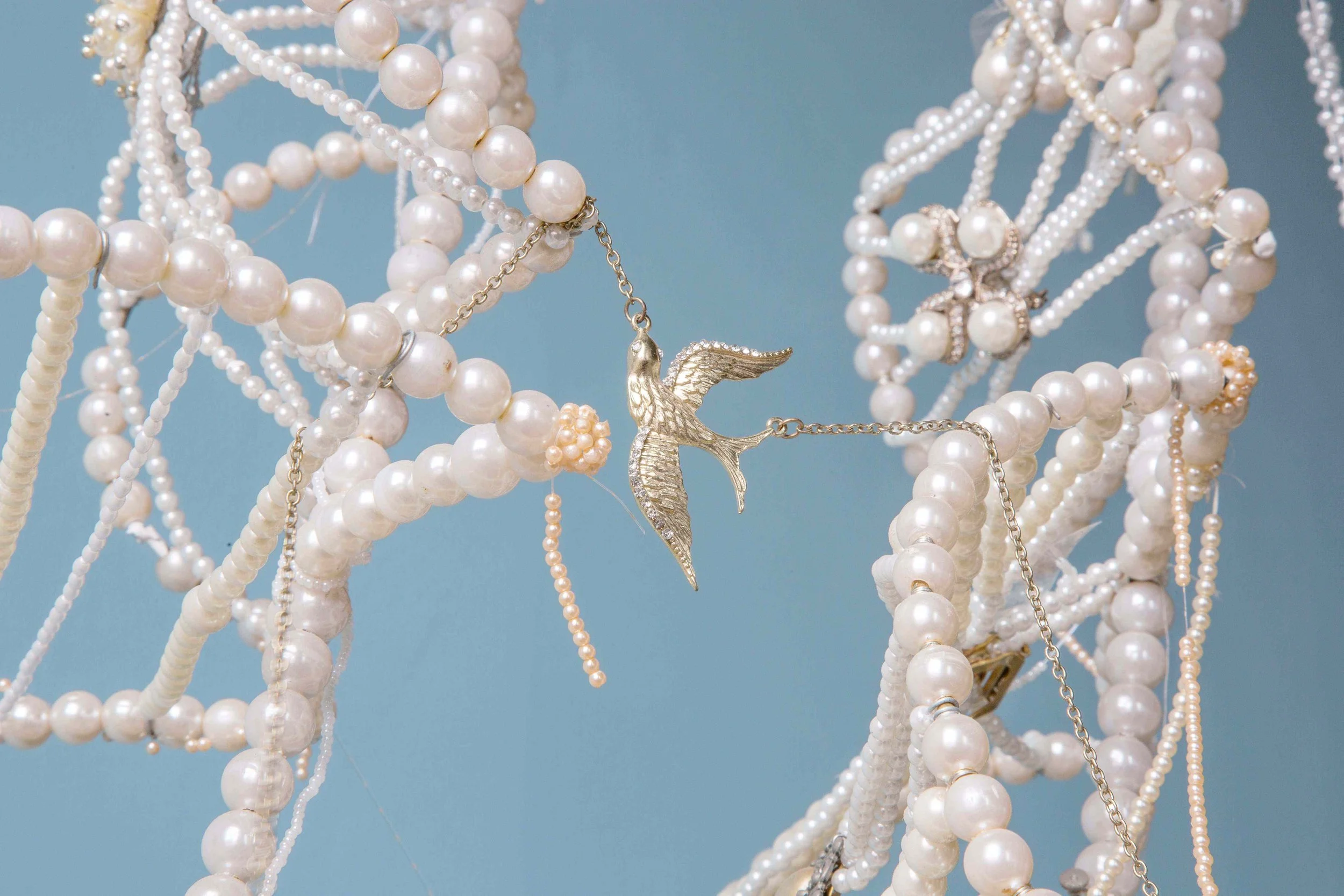
Ann Carrington, Wing Wo Wave, 2014, Mixed media including pearl necklaces, brooches and tiaras. Courtesy of the artist.
CB: Your sculptures were inspired in part by encounters with 17th-century vanitas paintings at the Rijksmuseum in Amsterdam, and your work frequently draws on the aesthetic codes of British historical art. How do these historical references shape your thinking, and what other historical sources have been influential in the development of your practice?
AC: I went to Amsterdam’s Rijksmuseum to look at the Dutch still life paintings of the 17th century - what are known as memento mori.. When these paintings were made the Golden Age would have been in full swing in the Netherlands, the economy flourishing with the importing and exporting of textiles, spices, metals and so on. The merchants were rich and getting richer. These elaborately detailed oil paintings depicting food on the table or incredible flower arrangements were popular additions to wealthy merchants’ homes. They really appealed to me - known as Vanitas, the paintings brim with symbolism intended to emphasise the futility of earthly pleasures and the pointlessness of seeking wealth, power, and glory.
When I looked at these pictures of half-consumed food and fading flowers, I realised the only things in these pictures that could possibly have survived to this day, still out in the world somewhere, were the silverware. This is when I first thought of making bouquets from cutlery. I looked at the pictures and metaphorically pulled everything out of it – the goblets, the flowers, the cutlery and then went about rearranging the objects as a three dimensional Vanitas bouquet for the 21st century.
I think of these artworks which combine hundreds of kitchen utensils to make extravagant flower arrangements as countering that notion of decay, by remaining in place, by not decomposing. They are insistent and perverse. I like them.
Using references from the past - from art history especially– adds a kind of gravitas to the pieces I make. The viewer may not explicitly understand the reference but the framework is somehow familiar and so provides a launch pad to explore more contemporary ideas and discussions. Perhaps this is like updating a classical story such as Baz Lurhmann’s remaking of Romeo and Juliet. Reincarnating the past and presenting it as new.

The Only True Protest is Beauty
Fondazione Dries Van Noten
April 25 - October 4, 2026
Ann Carrington is a multidisciplinary artist who centers discarded found objects as a fundamental element of her practice, with a particular focus on object multiples such as coins, buttons, and stamps. She works with elements of the mundane – silverware, barbed wire, pins and paintbrushes – which she transforms into busts, still lifes, vases, and tapestries. Carrington manipulates metal using laborious techniques such as soldering and welding, unraveling and rearranging the readymade associations and cultural histories of the material to give it new life in celebratory sculptural forms.
Carrington studied at The Royal College of Art, graduating in 1987, the Trent Polytechnic (1985), and the Bourneville College of Art (1981). In 1988 she received The Herbert Read Award, followed by the Commonwealth Fellowship for Sculpture in 1992 and two Arts Council of Great Britain awards in 1994 and 1997. She has created commissions for the United Nations and the Royal Family as well as having works in the permanent collections of the Victoria and Albert Museum, the Royal College of Art, and numerous private collections. She lives and works in Margate, England.
Camilla Boemio is an internationally published author, curator, and member of the AICA (International Arts Critics) based in Rome. She curates exhibitions in museums. Recent exhibitions include TEN YEARS: BSR People 14–24, a solo show by Antonio Palmieri at the British School at Rome (2024); The Bouvet Island by Stefano Cagol at the Museo Nazionale Etrusco di Villa Giulia (2024); and Gravity of the Wall by Amir Zainorin at the Museo delle Mura in Rome (2026). In 2013, Boemio was the co-associate curator of PORTABLE NATION: Disappearance as Work in Progress – Approaches to Ecological Romanticism, the Maldives Pavilion at the 55th International Art Exhibition La Biennale di Venezia. In 2016, Boemio curated Diminished Capacity, the First Nigerian Pavilion at the Venice Architecture Biennale. Her recent curatorial projects include her role as co-associate curator at Pera + Flora + Fauna. The Story of Indigenousness and The Ownership of History, an official collateral event at the 59th International Art Exhibition La Biennale di Venezia, 2022. Invitations to speak include the Tate Liverpool, MUSE Science Museum, and the Cambridge Festival 2021 at Crassh, in the UK.